


What Does Contemporary Tattoo Mean?
Contemporary tattoo is a way of making tattoos, defined by who designs the work and who it's made for. The artist draws an original piece for one client and one placement, and the studio exists to support that work.
Three questions sort it out quickly. Who designed this tattoo? Was it drawn for this body, or could it have gone on anyone? Does the person tattooing have a recognizable way of seeing? When the answers are the artist, this body, and yes, you're looking at contemporary work, whatever the subject.
Is Contemporary Tattoo a Style?
No. It's closer to a category of practice than a look. Some sites list "contemporary" next to traditional or Japanese as if it were one more style with its own rules. We think that misses the point. A fine line botanical and a blackwork back piece look nothing like each other, and both can come out of the same contemporary studio for the same reasons.
What Does "Contemporary" Mean Here?
Two things at once. The plain meaning is tattooing of the present, using current machines, current inks and current ideas. The second comes from the art world, where "contemporary" points to work that is made now and takes part in the conversation of its time. Our post on contemporary art and tattooing follows that second thread through the art itself. This page is about the practice and the studio.
Where Does the Term Come From?
Academics have used the words for decades. A 1996 master's thesis at Western Kentucky University, Kymberly Helbig's "An Exploration of the Self", described contemporary American tattooing as its own tradition of personal expression, worked out between the artist and the person being tattooed. There, "contemporary" describes tattooing at a moment in time.
As a form, contemporary tattoo took shape with Monolith Studio. We took a loose word, turned it into a form of tattooing with its own standards, and used the name to bring artists with very different styles under one roof. We come back to that further down.
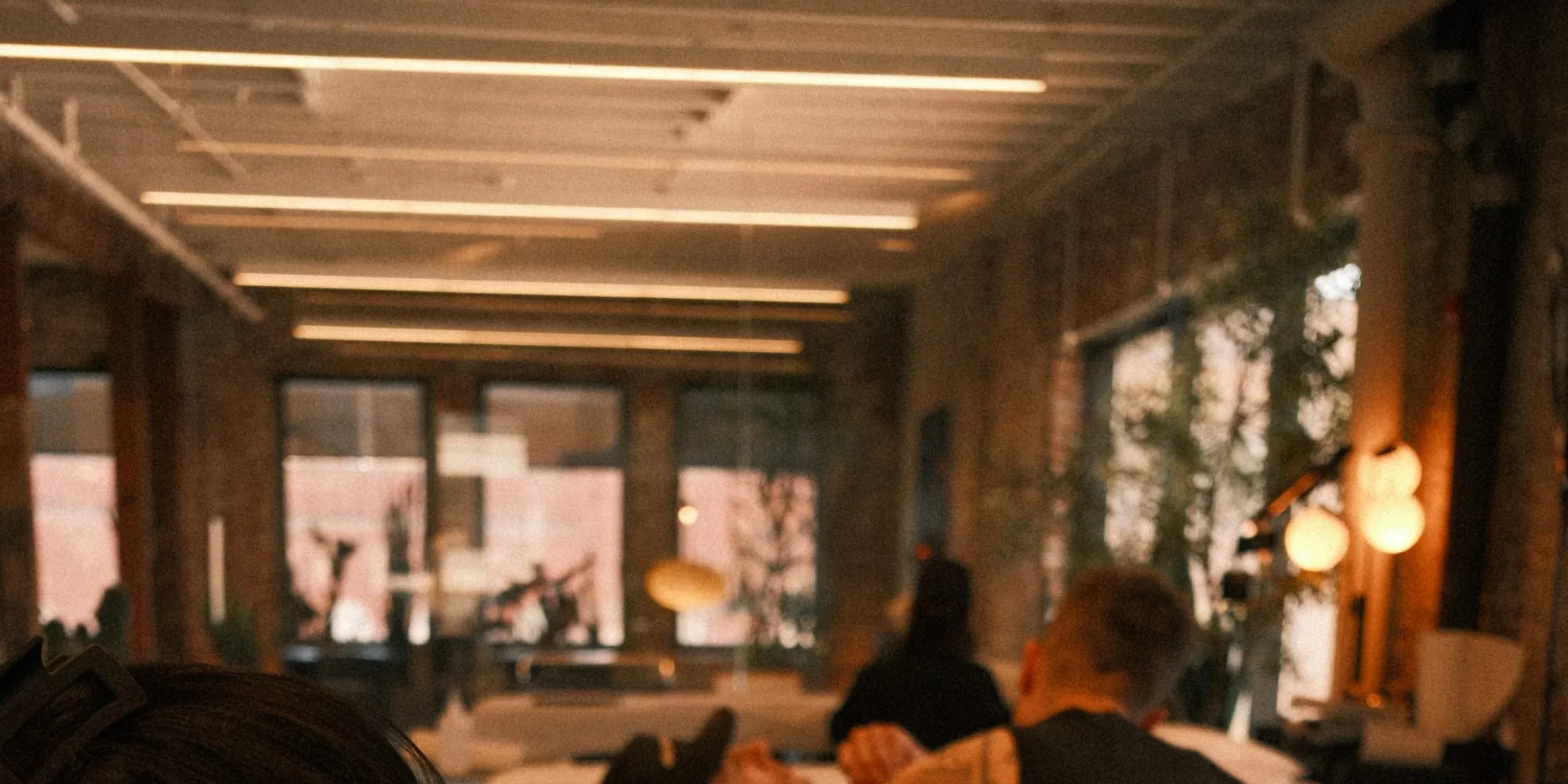
How Is a Contemporary Tattoo Studio Different From a Street Shop?
A street shop is built around the walk-in and the design on the wall. A contemporary tattoo studio is built around the artist and the commission. Both are real tattooing, and one doesn't replace the other, but they ask different things of the client and the artist.
The Street Shop Tradition
For much of the 20th century, American tattooing ran on flash: sheets of ready-made designs displayed in the shop. You came in, picked one and got it. Many of the eagles, flags and pin-ups that define American traditional tattoos came out of that world, and the best of it is still beautiful. It made tattooing fast, readable and affordable, and we have nothing but respect for the people who built it.
The Turn Toward Custom Work
The shift started long before anyone used the word contemporary. In 1974, Ed Hardy opened Realistic Tattoo in San Francisco. KQED describes him as "the first American to open an appointment-only tattoo studio", with no flash on display and custom pieces worked out with each client. Hardy had a printmaking degree from the San Francisco Art Institute and had studied tattooing in Japan. In the decades that followed, more people with art training came into the trade, and sociologist Mary Kosut described the resulting "artification" of tattooing, where parts of the field came to be valued as art from the inside.
Contemporary tattooing inherits all of that. The appointment and the original drawing used to be the exception. Now they're simply how the work gets done.
Artist-Led
Artist-led means tattooers make the decisions: who works there, what gets taken on, how the room runs. Monolith Studio's motto is "By tattoo artists, for tattoo artists." It was founded by two working tattooers, Okan Uckun and Oscar Akermo, and the people running the place have spent their careers on the other side of the machine.
Artist-Made
Artist-made means the person holding the machine drew the piece. Your artist isn't reproducing something off a wall or from a screenshot. Bring all the references you like; they tell the artist what you respond to. The design that comes back should be something that didn't exist before you asked for it. At Monolith, the rule on the studio page is that every tattoo should be a unique work of art.
Custom Work, Start to Finish
A custom tattoo is drawn for one person, in one place on the body. Scale, flow and placement get decided along with the image, which is why a design that works on a forearm usually can't just move to the ribs. At Monolith you first see your design in person at the start of your session, and time for adjustments is included, so the drawing can be fitted to you on the day.
The Client Experience
The room changes too. The design of a contemporary studio shapes how a tattoo feels to get. Light, calm and space matter when you're lying still for hours. People have also changed: Pew Research found in 2023 that 32% of American adults have a tattoo, so the old idea of the tattoo shop as a place on the edge of things doesn't describe who walks in anymore.
At Monolith we call the people we work with collectors, because a good tattoo is a piece of art that someone chooses to keep for life. The short comparison:
- A street shop often works from flash. A contemporary studio draws for you.
- A street shop is often walk-in. A contemporary studio books ahead, usually with a deposit.
- At a street shop you choose a design. At a contemporary studio you choose an artist.
- In a flash shop the sheet on the wall leads the design. In a contemporary studio the artist does.
What Kinds of Work Does Contemporary Tattooing Cover?
Almost anything, as long as it's drawn by the artist for the client. Most contemporary studios lean toward styles that grew up after the flash era and reward close looking. Our full guide to tattoo styles goes through each one. Below is only how they sit inside a contemporary studio, with real work from artists at Monolith Studio.
Fine Line and Micro Realism
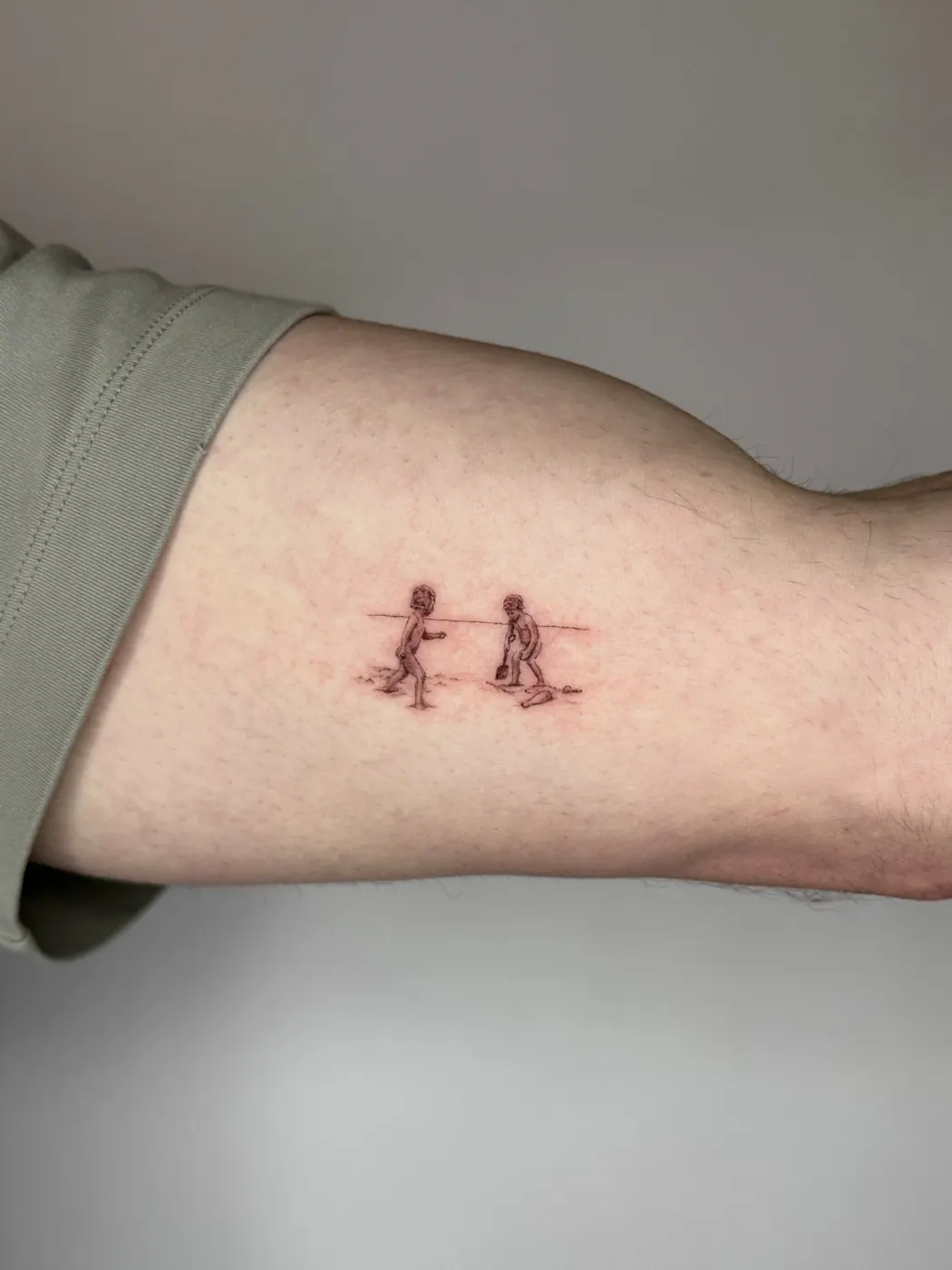
Fine line uses thin, precise lines, and micro realism packs photographic detail into a small space. Both ask for a steady hand and an honest conversation about size. In the row below, Sam's two tiny figures and Nadia's botanical stem are fine line, and Oksu's rider on a rearing horse shows how far detail can go in black and grey at a modest scale.


Realism and Black and Grey
Realism is where a tattooer's drawing is most exposed, since light, weight and anatomy either work or don't. Stevo works in black and grey realism, and the sculpted head below is a good example: the piece reads as stone, and the composition is built to fit the arm. Amalie Arsinevici works in the same field.

Ornamental, Calligraphy and Single Line
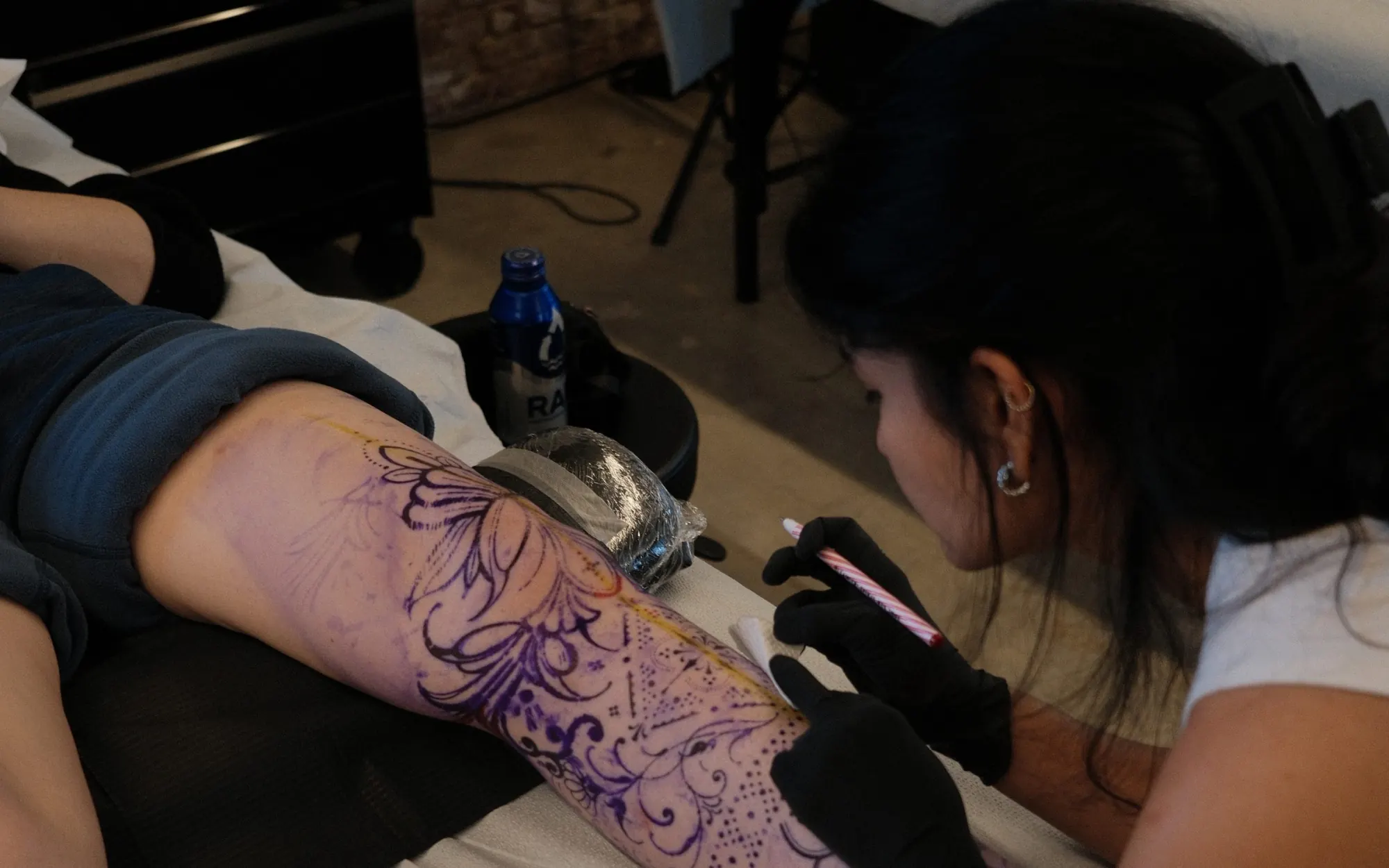
These styles live or die on how they follow the body. Ornamental work from Kaylee Ruiz and Kalodimas is drawn to the curve of a shoulder or the length of a leg. Noore brings Arabic calligraphy into tattoo lettering, and Mo Ganji is known for single line designs that say a lot with very little ink. The grid further down runs through this work, along with line work by RK and heavy black by Low.
Blackwork, Geometric and Engraving
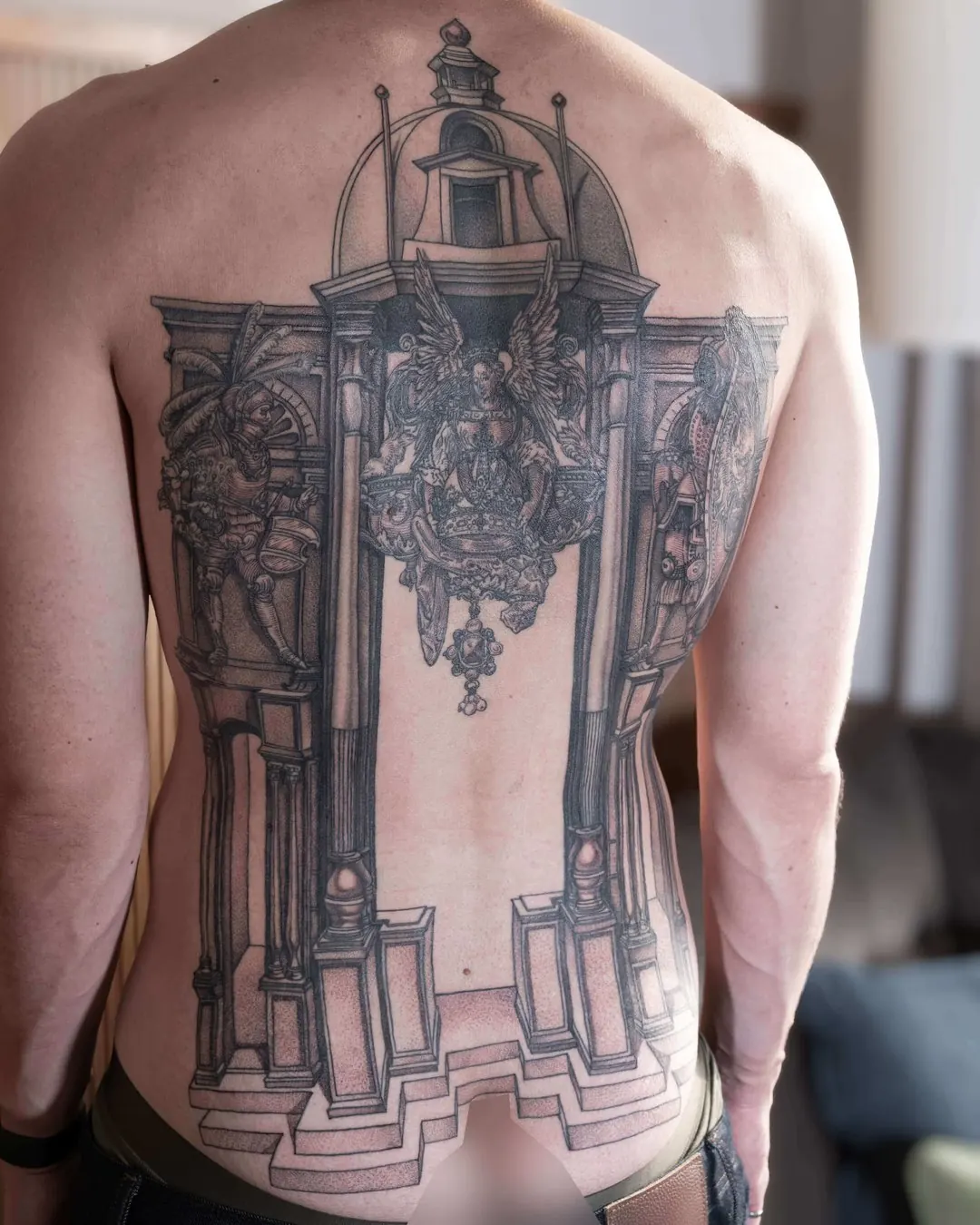
Blackwork, geometric and engraving styles often run large and treat the whole body as a composition. Maxime's architectural back piece below is one design for one back: the columns stand either side of the spine and the arch rises to the shoulders. You can't take that off a wall.


How Do You Find a Contemporary Tattoo Studio?
Look for a studio that sells artists, not designs, and that asks about your idea before it talks about a date. Calling yourself contemporary costs nothing, and more studios are doing it, so the word alone won't tell you much. These signs will.
- Each artist has a visible body of work. You should be able to tell one artist's portfolio from another's. If every page looks the same, the studio is selling a house style.
- Custom is the default. The site talks about your idea, your placement and your references. You aren't choosing from a catalog.
- Booking starts with questions. A good form asks about the idea, size and placement, and asks for a photo of the area. That's the artist starting to design.
- Tattooers run the place. Find out who founded the studio and whether they still tattoo.
- Prices come from the artist. Expect a range based on size, placement and complexity, plus a deposit to hold the date.
- The artists know their history. Ask where a style comes from. People who take the work seriously will have an answer.
The most useful thing you can do is choose the artist first and let the style follow. Our guide to choosing a tattoo artist in New York goes further on what to look for and what to ask.
What Is Monolith Studio's Part in Contemporary Tattoo?
Monolith Studio was founded in Brooklyn in 2024 as a home for this way of working. This is where contemporary tattoo became a form: a name, a set of standards and one roof for artists who speak very different visual languages. We use the term to bring those people together, and we've been giving it a specific meaning ever since.
Okan Uckun and Oscar Akermo started the studio after long careers in the trade. Okan studied architecture, took a master's in modern art and has tattooed full time since 2009. Oscar was trained in the classical arts by his father, an artist, and started as an apprentice in Sweden at 17. In an interview from July 2024, Okan said the studio's aim was to bring contemporary tattoo artists together from around the world and to "shape the direction of modern tattooing." Inked has since described Monolith as a contemporary tattoo studio too.
How Monolith Studio Defines Contemporary Tattoo
This is our definition, and we hold ourselves to it:
- Artist-led: tattooers run the studio, and the studio is built for tattooers.
- Artist-made: every piece is designed by the artist who tattoos it.
- Made for one person: the tattoo is original and drawn for that body.
- Open to any style: styles are tools, and we bring together artists with very different languages under one roof.
- Serious about the experience: the collector is part of the process from the first form to the last session.
The three values on our studio page say the same thing more simply: connection, uniqueness and creativity. Connection with the person wearing the work, a tattoo that's one of a kind, and a willingness to try what hasn't been tried. That's the new generation of tattooing as we see it. Other studios will define it their own way, and that's healthy. We'd rather argue about what the word means than watch it turn into a slogan.
How Has Contemporary Tattoo Changed the Tattoo Experience?
The person getting tattooed has gone from customer to collaborator. For a new generation of clients, a tattoo starts long before the needle: you choose an artist the way you'd choose a painter, you bring an idea, they bring a way of seeing, and the piece comes out of that conversation.
You Start With the Artist
The first decision used to be the design. Now it's usually the person. Many clients follow an artist's portfolio before they've settled on an idea, then come to that artist because of how they see. That changes the question from "can you do this?" to "what would you do with this?"
The Design Is a Conversation
Helbig's 1996 thesis described tattooing as an intimate negotiation between two people, ending in a piece of art that is "yours, mine and ours." That's a fair description of a good session today. You arrive with a story and a body. The artist answers with a drawing, and the two of you adjust it until it belongs to both.
The Studio Is Part of the Work
The space shapes how people treat the work and each other, and a studio built with care says tattooing has left its old stigma behind. If you're going to lie still for hours and keep the result for life, the room should take that seriously. Light, calm and privacy aren't decoration. They're part of what you came for.
The Tattoo Is Treated as Art
This is why we say collectors at Monolith. It's a small word with a big shift behind it: a tattoo is an artwork you chose, by an artist you chose, and you carry it for the rest of your life. Once you see it that way, the whole experience follows, from the first form to the last session.
Contemporary Tattoo FAQ
What is a contemporary tattoo?
A contemporary tattoo is a custom piece designed by the artist who tattoos it, for one person and one placement. The term describes how the work is made, so it can cover many looks, from fine line to blackwork. There's no official definition; this is how Monolith Studio uses the term.
Is contemporary tattoo a style?
Not really. Some sites treat it as a style, but we use it as a wider category of practice. Fine line, micro realism, realism, ornamental, blackwork and calligraphy can all be contemporary. What they share is an original design by the artist, made for one client rather than taken from a sheet of flash.
What's the difference between traditional and contemporary tattoos?
American traditional is a style with bold lines, a limited palette and classic flash subjects. Contemporary describes a way of working: custom design, led by the artist. The two can overlap, since a contemporary artist can draw an original piece in a traditional style. The real difference is who designs the tattoo, and for whom.
What is a contemporary tattoo studio?
A contemporary tattoo studio is a studio built around artists and custom work instead of walk-ins and flash. Artists usually have their own recognizable styles, clients book ahead and choose an artist first, and each piece is drawn for that client. Researchers have also used the term to set these studios apart from traditional parlours.
Who came up with the term contemporary tattoo?
No one person can be credited. Academics were writing about contemporary tattooing by the 1990s, and the phrase has been used in different ways since. Monolith Studio adopted "contemporary tattoo studio" as its name and position when it was founded in Brooklyn in 2024, and this page sets out how we define it.
How much does a contemporary tattoo cost?
It depends on the artist, size, placement and complexity of the design, so there's no single price. At Monolith Studio each artist sets their own rates and gives you an estimated range. A non-refundable deposit reserves your date and time, so ask about it when you book. Bigger, more detailed work costs more.
Contemporary Tattoo in Brooklyn
Monolith Studio is a contemporary tattoo studio at 77 Washington Avenue, Brooklyn, NYC, where resident and guest artists work across fine line, micro realism, realism, blackwork, ornamental work and calligraphy. If you know whose work you love, start on our artists page. If you don't, the booking form can ask us for a recommendation.
Tell us the idea, the placement and the size, and send your references with a photo of the area. We'll get back to you with details within 48 hours. Book your experience when you're ready, and read our tattoo preparation guide before your session.
Image credits: studio photographs from Monolith Studio, Brooklyn. Tattoos by Sam, Nadia, Oksu, Stevo, Maxime, Kaylee Ruiz, Kalodimas, Noore, Mo Ganji, RK and Low.


