Cybersigilism
What is Cyber Sigilism?
Where Cyber Sigilism Comes From
Cyber sigilism (also spelled cybersigilism) is a tattoo style that merges two distinct visual traditions: the ancient practice of sigil creation — the design of symbols charged with personal or spiritual meaning — and the futuristic aesthetics of cyberpunk culture, digital art, and science fiction. The result is a tattoo style defined by thin, precise black lines; sharp angular forms; intricate interlocking geometry; and a visual density that rewards close inspection.
The style emerged in the early 2020s, driven primarily by social media and the growing cultural interest in both esoteric symbolism and digital aesthetics. By 2025 it had become one of the most searched tattoo styles online, with a global community of artists and collectors developing its visual language at a rapid pace.
What does cyber sigilism mean? The term combines "cyber" — referencing technology and the digital world — with "sigilism", the practice of creating sigils: symbols imbued with specific magical or personal intent. A cyber sigilism tattoo is not just a geometric design; it is a symbolic system built around the wearer's personal intentions, beliefs, or identity, rendered in the precise visual language of the digital age.
Key visual characteristics of cyber sigilism:
Thin, precise linework: Cyber sigilism relies on extremely fine lines — thinner than almost any other tattoo style. The precision required is extraordinary; a line that deviates even slightly from its intended path is immediately visible in the style's geometric compositions.
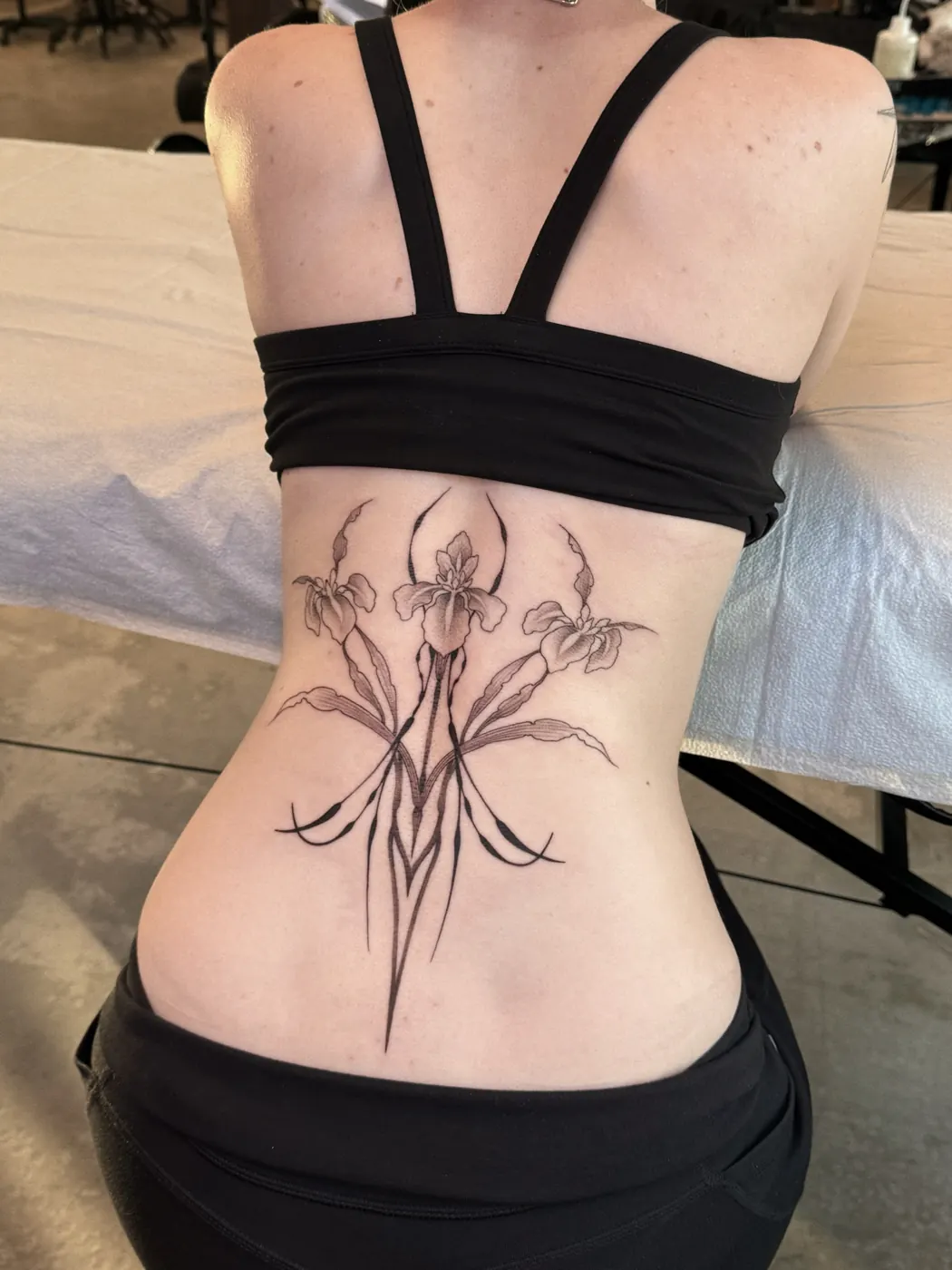
Angular, geometric forms: Unlike the flowing curves of ornamental or floral tattooing, cyber sigilism favors sharp angles, points, and the geometric vocabulary of circuit boards, runes, and digital interfaces. Many artists now bend the style toward softer shapes too: RK, for example, pulls orchids and lilies into the same barbed, tapering lines.
Symbolic density: The best cyber sigilism pieces carry layers of symbolic meaning embedded in their forms — personal sigils, sacred geometry, runic references, and digital iconography woven into a single cohesive composition.
Negative space as structure: The deliberate use of bare skin as part of the composition — negative space creating visual rhythm and breathing room within dense geometric forms — is central to the style's visual logic.


Cyber Sigilism Tattoo Designs and Ideas
Cyber sigilism accommodates a wide range of personal symbolism and visual approaches. Here are the most compelling design directions:
Personal Sigil Tattoos
The most conceptually meaningful cyber sigilism pieces begin with a personal sigil — a symbol designed to encode a specific intention, belief, or identity. Working with an artist to create a bespoke sigil and then render it in the cyber sigilism visual language produces a piece that is genuinely unique: symbolic content translated into a form that carries both personal and aesthetic weight.
Cyber Sigilism Arm and Forearm Tattoos
The forearm and outer arm are the most popular placements for cyber sigilism. The flat surface of the forearm suits the style's linear precision and allows for the kind of extended compositions — geometric forms that flow from wrist toward elbow — that showcase the style's architectural quality. RK often runs a single red or blue line from the shoulder to the wrist and lets it split around the elbow.
Cyber Sigilism Spine Tattoos
The spine is a natural fit for cyber sigilism's vertical, architectural compositions. A cyber sigilism spine tattoo — a continuous column of interlocking forms running from the neck to the lower back — has become one of the defining images of the style. The symmetry of the spine suits the style's bilateral compositions particularly well.
Cyber Sigilism Back Tattoos
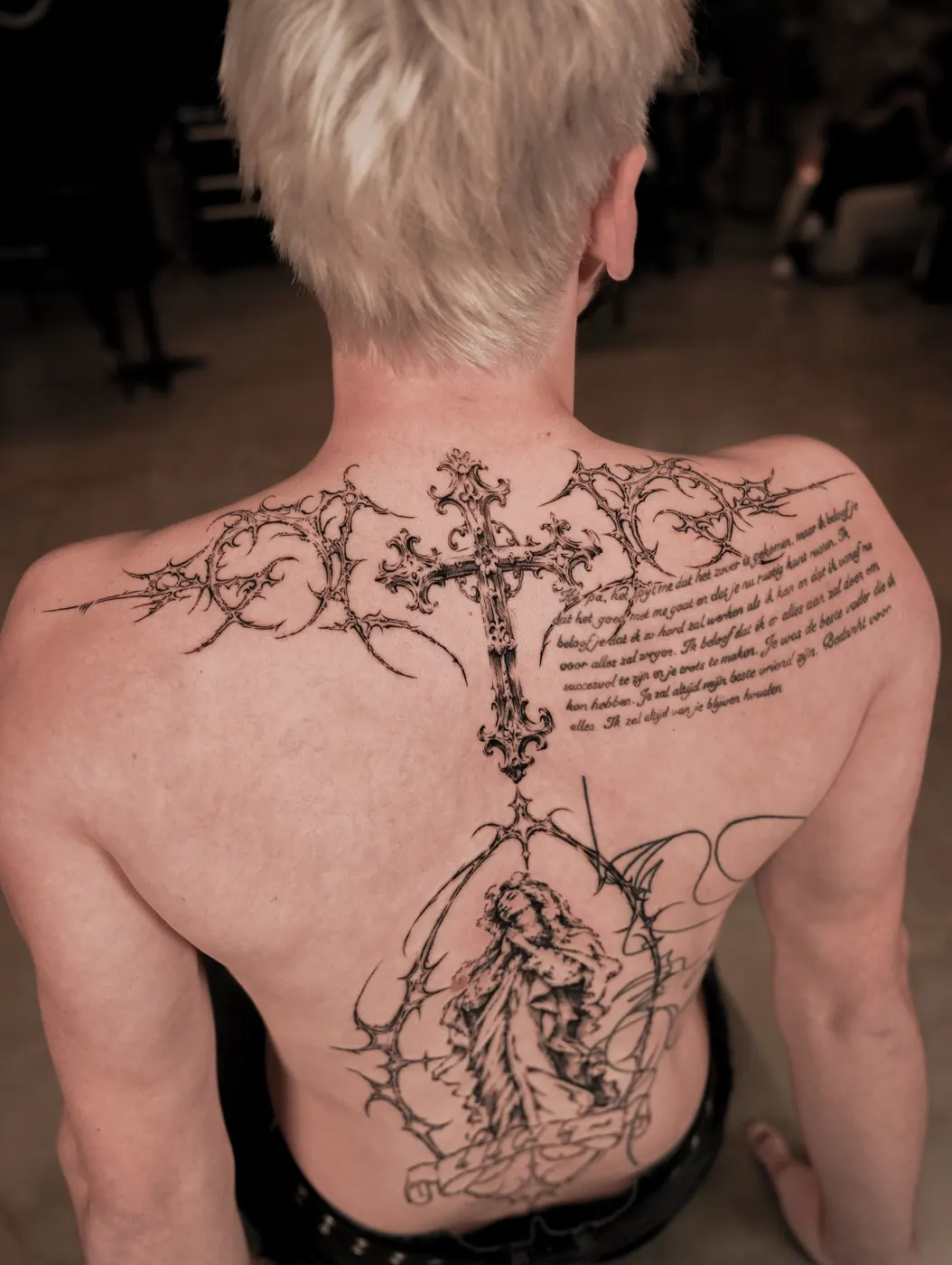
Large-scale cyber sigilism back pieces represent the style at its most ambitious. The back provides canvas for the kind of full architectures — interlocking symbols, radiating forms, dense layered linework — that can only be fully appreciated at scale. JZ's full back shown at the top of this page mixes a cross, script and a figure inside a thorned frame.
Cyber Sigilism Hand and Neck Tattoos
High-visibility placements — the hand, the neck, the collarbone — suit cyber sigilism's bold forms particularly well. The style's precision and the striking visual impact of its angular linework make these placements especially powerful, though they require significant commitment and are best suited to collectors with extensive prior tattoo experience.
The Technique Behind Cyber Sigilism Tattoos
Cyber sigilism is one of the most technically demanding tattoo styles to execute well. The defining characteristic of the style — extremely fine, precise linework forming complex compositions — leaves no margin for error.
Line precision: The style requires a level of line control that distinguishes the best cyber sigilism artists from the rest. Consistent line weight, clean tapers at the end of every spike, and long lines pulled in one motion are fundamental skills.
Composition design: A cyber sigilism tattoo must be designed as a unified whole — not assembled from separate elements. For a large piece the stencil is often printed and cut into sections, so each part can be placed on the curve of the body on its own.
Skin placement and flow: The style's lines interact with the body's curves and planes in specific ways. An experienced cyber sigilism artist designs with the body, not just on it.
Cyber Sigilism Meaning
Cyber sigilism occupies a unique position in contemporary tattooing because it combines two distinct layers of meaning. At the visual level, it draws on the symbolic vocabulary of ancient sigil traditions. At the aesthetic level, it reflects a specifically contemporary sensibility: the beauty of digital systems, the precision of code, the visual language of a generation that has grown up in a technological world. For collectors drawn to the style, these two layers are inseparable — the personal symbolism of the sigil and the cultural symbolism of the digital aesthetic reinforce each other.


Cybersigilism Tattoo Placement Guide
Forearm: The most popular cybersigilism placement. The flat surface and linear orientation of the forearm suits the style's compositions perfectly. Both the inner and outer forearm work well — inner for more intimate, personal pieces; outer for bolder, more visible compositions.
Spine: Cybersigilism's vertical forms are a natural fit for the spine. A spine piece becomes a continuous composition running the full length of the back — one of the most visually striking placements in the style.
Back: Full back cybersigilism pieces represent the style's most ambitious application. The scale allows for the full complexity of the style's language, with interlocking systems of forms that can only fully breathe at this size.
Upper arm and shoulder: The shoulder and upper arm suit cybersigilism compositions that can wrap around the body's curves. The shoulder blade in particular provides excellent canvas for mirrored compositions, like RK's pair of orchids above.
Legs: A thigh or knee piece can follow the muscle in a way flat placements can't. Long lines that cross the knee read as one shape when the legs move.
Chest: Symmetrical cybersigilism chest pieces — compositions that mirror across the sternum — are among the most powerful applications of the style.
Hands and neck: High-commitment placements where the style's precision and visual impact are maximally visible. Best approached by collectors who are serious about the style and have significant prior tattoo experience.
How Long Does a Cybersigilism Tattoo Take?

Cybersigilism vs. Geometric Tattoos: What's the Difference?
Geometric tattooing and cybersigilism share a commitment to precision, but they operate in distinct visual registers. Geometric work is built from measured shapes, circles, grids and sacred geometry. Cybersigilism uses freer, sharper lines that taper into spikes and thorns and follow the body. See our geometric tattoo guide for more on how these styles compare. For the most minimal end of the precision spectrum, see our single line tattoo guide. Browse all tattoo styles at Monolith Studio.


Cybersigilism at Monolith Studio: RK and JZ
Two of our resident artists tattoo cybersigilism, and they come at it from different directions.
RK trained in painting and printmaking before tattooing, and works both by machine and by hand poke. Her cybersigilism grows out of plants: orchids, lilies and irises stretched into long, tapering lines that end in hooks and spikes. She places them on the back, the spine, the shoulder blades and the arms, sometimes in red or blue ink instead of black. The lines are drawn to the body first, so a back piece follows the shoulder blades and the spine rather than sitting flat on top of them.
JZ is known for fine line and micro realism, and he brings that detail into the style. His recent full back for a client who traveled in for it combines a cross wrapped in thorned lines, a block of script, and a praying figure set inside a thorned frame. The design was printed and cut into sections before the session so each part of the stencil could be placed separately. JZ tattooed it over two days.
Every piece is drawn for the person wearing it. We don't tattoo cybersigilism from flash.
Monolith Studio, 77 Washington Avenue, Brooklyn, NYC 11205.

How to Book a Cybersigilism Tattoo at Monolith
Start with a consultation request, or go straight to RK's booking page or JZ's booking page if you already know whose work you want.
Things that help your artist:
- The placement and a rough size (a photo of the area helps)
- Two or three of the artist's own pieces you like, so they can see which direction you lean
- Any symbols, words or shapes you want worked in
- Whether you want black only, or red or blue lines like some of RK's pieces
Large pieces are usually split into several sessions. If you're traveling to Brooklyn for it, tell us when you book and we'll plan longer sessions.


Cybersigilism is tattooing at the intersection of the ancient and the contemporary — symbolic systems thousands of years old rendered in the precise visual language of the digital age. It is demanding to execute, deeply personal in its meaning, and visually unlike anything else in contemporary tattooing. See more of RK's and JZ's work, or book a consultation and let's begin.
FAQ
A cybersigilism tattoo is a contemporary tattoo style characterized by fine-line blackwork, sharp angles, flowing S-shaped curves, and cyber-organic patterns. The designs combine the visual language of digital aesthetics, circuitry, and futuristic geometry with the concept of the sigil — a symbol charged with personal or symbolic intent. The result is a style that feels simultaneously ancient and futuristic, technical and deeply personal.
The name combines two concepts: "cyber," referencing digital culture and modern technology, and "sigil," a word historically used to describe symbolic marks intended to carry meaning or power. In cybersigilism tattooing, meaning is not fixed or universal — unlike traditional symbolic tattoos, these designs carry personal significance determined by the wearer. The abstraction of the style is intentional, allowing each piece to encode whatever narrative or intention the collector brings to it.
Cybersigilism tattoos work well on visible areas where the angular, flowing designs can interact with the body's natural contours. The forearm, upper arm, chest, neck, and spine are all strong placements. Because cybersigilism designs often follow the body's anatomy as part of their visual logic, the placement conversation with your artist is especially important — where the design lives on the body fundamentally shapes how the finished piece reads.
Cybersigilism tattoos work well on visible areas where the angular, flowing designs can interact with the body's natural contours. The forearm, upper arm, chest, neck, and spine are all strong placements. Because cybersigilism designs often follow the body's anatomy as part of their visual logic, the placement conversation with your artist is especially important — where the design lives on the body fundamentally shapes how the finished piece reads.
Yes — but unlike rune tattoos or traditional symbols, cybersigilism tattoos don't rely on fixed or universally defined meanings. The significance is personal, encoded by the wearer rather than dictated by the style. For many collectors, cybersigilism represents their relationship with technology and digital identity. For others, it is a way to create a personal talisman or mark of transformation. Some collectors choose the style purely for its visual impact — and that is equally valid.
Session length for cybersigilism tattoos depends heavily on scale and density. A smaller piece with focused linework might take 2 to 3 hours. Large-scale compositions covering the back, chest, or a full sleeve require multiple sessions. Because cybersigilism relies on extremely precise fine-line execution, the work cannot be rushed — each angular line and flowing curve needs to be placed with full intention and control.
Cybersigilism tattoo pricing at Monolith Studio in Brooklyn depends on the scale, density, and complexity of the design. Because the style demands high technical precision in fine-line execution, it is priced accordingly. Visit monolithstudio.com/book-experience to submit your project and get a personalized quote from the team.
Resident artists RK and JZ tattoo cybersigilism at Monolith Studio in Brooklyn. RK builds the style out of plants: orchids, lilies and irises stretched into long barbed lines across the back, spine and arms, sometimes in red or blue ink. JZ brings his fine line and micro realism detail into larger pieces, like the full back shown on this page. Every piece is drawn from scratch for the person wearing it. See RK's work and JZ's work, or request a consultation.
Artists


Related Styles