Blackwork Tattoo
What is a Blackwork Tattoo?

What is a Blackwork Tattoo?
A blackwork tattoo is any tattoo created exclusively with black ink — no color, no grey wash shading in the traditional sense, just the full tonal range achievable through black alone. Within that definition, blackwork is one of the most diverse styles in all of tattooing, ranging from the bold geometric patterns of tribal traditions to the dense, architectural complexity of contemporary blackwork sleeves.
The term "blackwork" encompasses several distinct sub-styles, each with its own visual vocabulary and historical roots:
Tribal blackwork: The oldest form, rooted in Polynesian, Maori, Filipino, and other indigenous tattooing traditions. Bold, graphic, and deeply symbolic — tribal blackwork uses solid black shapes and negative space to create designs that carry cultural and spiritual weight.
Geometric blackwork: Uses precise mathematical forms — lines, circles, triangles, polygons — to create structured, symmetrical compositions. Geometric blackwork draws on sacred geometry, architecture, and contemporary graphic design to produce tattoos of striking visual clarity.
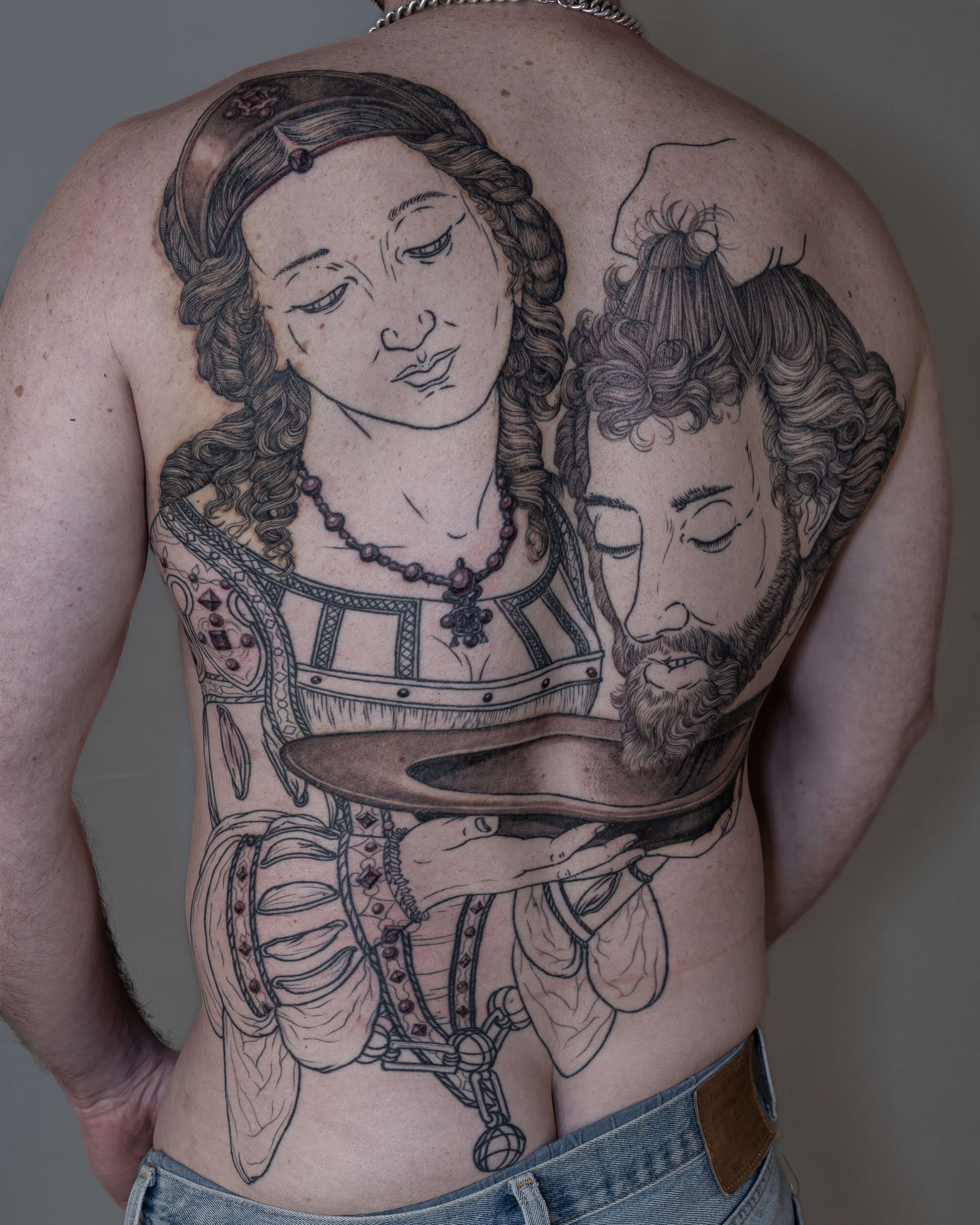
Illustrative blackwork: Combines detailed figurative imagery with the bold linework and high contrast of the blackwork aesthetic. Animals, portraits, botanical studies, mythological figures — all rendered without color, relying entirely on line quality and tonal contrast.
Dotwork: A technique within blackwork that builds form and shadow through clusters of individual dots rather than solid fills or hatched lines. Dotwork produces a unique textured quality that rewards close inspection.
Blackout: Large areas of solid black ink used as coverage, negative space design, or bold graphic statement. Blackout tattooing has surged in popularity as both a standalone aesthetic and a cover-up technique.
Blackwork Tattoo Designs and Ideas
The blackwork style accommodates an almost unlimited range of subject matter. The unifying principle is not what is depicted, but how — through the exclusive use of black ink and the visual power that comes from contrast, line, and form. Here are the strongest blackwork design directions:
Geometric Blackwork Tattoos
Geometric blackwork is among the most requested styles at contemporary studios. These designs use precise linework, repeating patterns, and mathematical symmetry to create compositions of extraordinary visual logic. Sacred geometry — mandalas, metatron's cube, the flower of life, golden ratio spirals — provides a rich vocabulary for geometric blackwork. These tattoos read beautifully at all scales, from small wrist pieces to full sleeves.
Blackwork Floral Tattoos
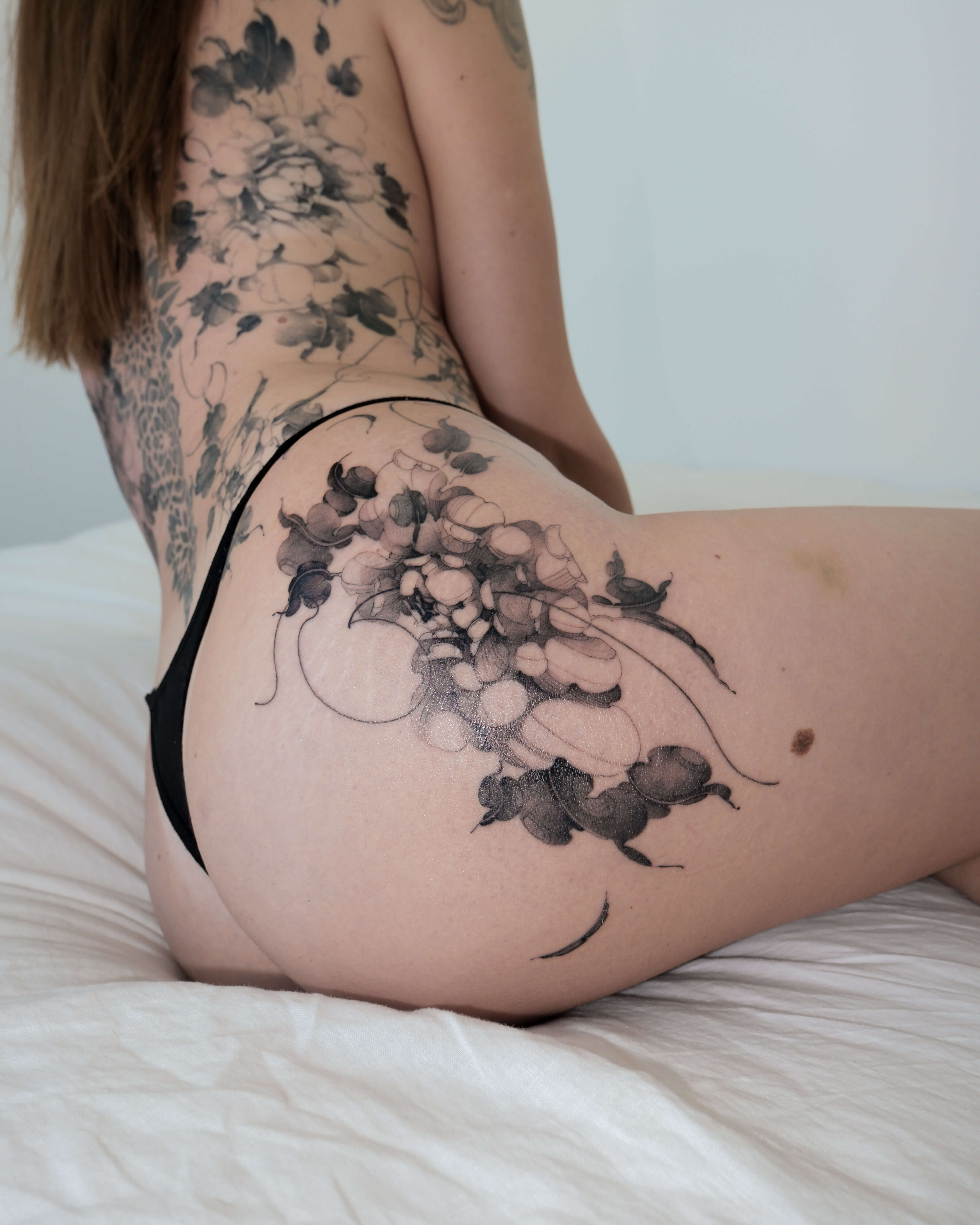
Floral blackwork demonstrates the full expressive range of the style. Without color, the form and structure of botanical subjects become the entire focus — the curve of a petal, the geometry of a seed head, the radiating lines of a chrysanthemum. Blackwork florals can range from delicate fine-line botanical studies to bold, graphic compositions where solid black shapes define the flower against bare skin.
Blackwork Animal Tattoos
Animals rendered in blackwork — wolves, ravens, owls, tigers, koi, snakes — carry a raw visual power that color work rarely matches. The high contrast of black on skin forces a graphic simplification of form that often results in more striking imagery than a fully rendered color piece. The blackwork wolf, in particular, has become one of the defining images of contemporary blackwork.
Blackwork Sleeve Tattoos
A blackwork sleeve is one of the most visually commanding tattoo projects possible. Whether built around a central theme — geometric pattern, botanical study, Japanese-influenced imagery, or abstract composition — a full blackwork sleeve achieves a level of visual cohesion and impact that color sleeves rarely match. The sleeve becomes a single, unified graphic statement from shoulder to wrist.
Blackwork Portrait Tattoos
Blackwork portraits strip away the complexity of realistic skin tone and color, focusing entirely on the structure of the face — the architecture of light and shadow, the quality of the line, the graphic weight of dark against light. When executed well, a blackwork portrait is more psychologically intense than a realistic color portrait.
Tribal and Neo-Tribal Blackwork
Traditional tribal blackwork — Polynesian, Maori, Filipino, indigenous American — remains one of the most powerful visual traditions in all of tattooing. Contemporary neo-tribal work draws from these traditions while creating new visual languages rooted in their principles: bold forms, graphic contrast, and the deep visual logic of pattern-making that has been refined across thousands of years.
Blackwork Tattoo Technique
Blackwork tattooing demands a precise and confident technical approach. Because there is no color to distract the eye, every line, every edge, every tonal transition is fully visible — technique cannot hide behind color complexity. The key technical elements of blackwork include:
Linework: The foundation of blackwork. Lines must be clean, confident, and consistent — a shaky or inconsistent line in a blackwork tattoo has nowhere to hide. Linework quality is the single most visible marker of an experienced blackwork artist.
Solid fills: Large areas of solid black ink are a defining element of many blackwork styles. Achieving a truly even, opaque black fill requires multiple passes and a thorough understanding of how black ink settles in different skin types.
Negative space: In blackwork, what is left untattooed is as important as what is filled. The deliberate use of negative space — bare skin as part of the design — is central to the visual logic of blackwork composition.
Dotwork texture: The controlled placement of dots to build gradients, texture, and shadow is one of the most technically demanding aspects of blackwork. The spacing and density of dots determines the tonal value — requiring precise control and consistency across large areas.
Blackwork Tattoo Meaning
Blackwork tattoos carry meaning on multiple levels. At the most immediate level, the choice of blackwork over color signals a commitment to permanence and graphic power — black ink outlasts all other pigments, maintaining its visual impact for decades longer than color work. At a deeper level, blackwork connects the wearer to one of the oldest human traditions: the use of dark pigment to mark the body in ways that carry spiritual, cultural, and personal significance. Whether the design is tribal, geometric, illustrative, or abstract, blackwork carries a visual authority that reflects the full weight of that history.
Blackwork Tattoo Placement Guide
Full sleeve: The defining blackwork placement. A blackwork sleeve — whether geometric, illustrative, or tribal — achieves a level of visual unity and impact that makes it one of the most striking tattoo projects possible. Read our tattoo sleeve guide for planning advice.
Back: The largest available canvas. Full back blackwork pieces — geometric mandalas, large-scale illustrative compositions, neo-tribal coverage — are among the most ambitious tattoo projects. The scale allows for a complexity and detail impossible on smaller placements.
Chest: Particularly well-suited to symmetrical blackwork compositions centered on the sternum — mandalas, geometric patterns, paired botanical or animal designs. The chest is a powerful placement for designs with strong visual symmetry.
Forearm: The most visible everyday placement. A blackwork forearm piece — whether a single bold design or the beginning of a sleeve — is a constant visual presence. The flat inner forearm is especially suited to linework-heavy pieces with fine detail.
Thigh: An increasingly popular blackwork placement offering a generous canvas without the permanence of arm or chest coverage. Large geometric or illustrative blackwork pieces sit particularly well on the thigh.
Hands and neck: High-visibility placements where blackwork's graphic boldness makes a particularly strong statement. These placements require serious commitment and are best approached after extensive prior tattoo experience.
How Long Does a Blackwork Tattoo Take?

Blackwork vs. Fine Line: Which Is Right for You?
Blackwork and fine line tattooing represent two ends of the visual spectrum in black ink work. Fine line prioritizes delicacy — thin, precise lines creating intricate detail at small scale. Blackwork prioritizes impact — bold forms, high contrast, graphic power at any scale. Fine line work is best suited to smaller pieces where detail is the focus. Blackwork excels in larger compositions where visual weight and lasting impact matter most. Both styles age well when executed by experienced artists, but blackwork's bold lines and solid fills maintain their visual presence more reliably over decades than the fine lines of delicate work.
If you're drawn to both, contemporary blackwork often incorporates fine line elements within larger bold compositions — a hybrid approach that captures the best of both traditions. See our geometric tattoo guide for more on how precision linework integrates into structured blackwork compositions.
Blackwork Tattoo Studio in Brooklyn, NYC — Monolith Studio
If you're searching for the best blackwork tattoo artist in New York City, Monolith Studio in Brooklyn brings together artists whose blackwork spans the full range of the style — from precise geometric compositions to bold illustrative blackwork, neo-tribal coverage, and complex dotwork.
Located at 77 Washington Avenue, Brooklyn, NYC 11205, Monolith approaches every blackwork project as a serious design commission — custom work rooted in the specific visual tradition the client is drawn to, executed with the technical precision that blackwork demands.
What sets Monolith's blackwork apart:
- Full custom designs — no flash, no shortcuts
- Deep technical mastery of linework, solid fills, dotwork, and negative space composition
- Artists experienced across all blackwork sub-styles: geometric, illustrative, tribal, dotwork, and blackout
- Brooklyn studio — accessible from all five boroughs and Manhattan
Looking for the best blackwork tattoo artist in NYC? Book your consultation at Monolith Studio and let's build something together.
The History of Blackwork Tattooing
Blackwork is not a recent invention. It is the oldest form of tattooing on record. The earliest confirmed tattoos in human history — found on Ötzi the Iceman, a 5,300-year-old mummy discovered in the Alps — were executed entirely in black, in simple geometric lines and marks. Similar black geometric tattooing has been documented across Polynesia, indigenous North America, ancient Egypt, and pre-colonial Southeast Asia. Black ink, applied boldly to skin, is the foundation upon which every tattoo tradition on earth was built.
In the Western tattoo tradition, blackwork experienced a major revival in the 1970s and 1980s, driven partly by the influence of Polynesian tribal tattooing — particularly the work of Leo Zulueta, widely credited as the founder of the neo-tribal blackwork movement. Zulueta's work introduced Polynesian graphic logic — bold fills, geometric precision, the interplay of solid black against skin — to a Western tattooing culture that had been dominated by American traditional color work.
Through the 1990s and 2000s, blackwork expanded dramatically. The rise of geometric tattooing, sacred geometry, and European dark art illustration all contributed to a style that now encompasses everything from precise mathematical compositions to large-scale blackout coverage. Today blackwork is one of the most collected and critically respected categories in contemporary tattooing.
Blackwork Tattoo Meaning
Blackwork carries meaning on multiple levels. At the formal level, the choice of black ink alone is a statement — a commitment to permanence, boldness, and the graphic power of contrast over the decorative appeal of color. Many collectors are drawn to blackwork precisely because it feels more serious, more committed, more architecturally considered than colored work.
At the symbolic level, blackwork subjects carry the same range of meaning as any tattoo subject. Geometric blackwork often references sacred geometry, spiritual systems, and mathematical order. Neo-tribal blackwork connects to ancestral traditions and cultural identity. Illustrative blackwork draws from a wide vocabulary of symbolism — botanical, zoological, mythological, personal. The meaning is always specific to the collector and the subject; the style of blackwork execution gives it visual authority.
Blackout Tattoos — The Most Radical Form of Blackwork
At the furthest end of the blackwork spectrum sits the blackout tattoo — a style defined by covering large areas of skin with solid, dense black ink, creating fields of pure black coverage. Blackout tattooing has evolved from an extreme subculture practice to one of the most visually striking and widely collected styles in contemporary tattooing.
Blackout pieces can be approached in several ways. Pure blackout coverage — filling an entire limb or body section with solid black — creates a maximally graphic, almost sculptural effect. Negative space blackout uses solid black fields to frame and define un-inked skin, creating intricate patterns that emerge from the contrast between ink and bare skin. Blackout as cover-up uses dense black coverage to reclaim heavily worked or poorly aged skin, offering collectors a powerful path to a coherent, intentional aesthetic from previously complex or unwanted work.
The technical demands of blackout work are significant. Achieving truly solid, even black coverage requires exceptional ink saturation technique — the ability to pack ink densely without blowing out lines or creating inconsistent tonal fields. A poorly executed blackout piece heals patchy and uneven; a well-executed one heals as a uniform, matte field of pure graphic black.
If blackout coverage interests you — whether as a statement piece, a cover-up solution, or as part of a larger blackwork composition — book a consultation at Monolith Studio to discuss what's possible with your specific skin and placement.
Blackwork is tattooing stripped to its essentials — the full power of black ink, wielded with intention. Whether you're drawn to the mathematical precision of geometric work, the bold graphic weight of tribal traditions, the narrative depth of illustrative blackwork, or the radical commitment of large-scale blackout coverage, the style rewards the collector who chooses it with something genuinely timeless.
At Monolith Studio, blackwork is executed at the highest level — custom, considered, and built to last. Book a consultation and let's begin.
FAQ
Artists

.avif)




Related Styles
.jpg)