
What Does a Back Tattoo Mean?
Back tattoos carry a different symbolic weight than tattoos placed almost anywhere else on the body. The back is a canvas you yourself rarely see — it exists primarily for others to witness, or as a piece of personal meaning the wearer carries without constantly observing. This asymmetry between visibility and intimacy shapes what a back tattoo means and why people choose this placement specifically.
Commitment and Scale
Choosing a back tattoo is, more than almost any other placement, a statement of commitment. Back pieces — particularly full back and upper back compositions — require significant time, financial investment, and physical endurance. The decision to dedicate the largest canvas on the body to a single design or unified composition reflects a willingness to commit at a scale most other placements do not demand. This is why historic full back traditions, from Japanese irezumi to old-school American back panels, have always carried associations with seriousness and devotion.
Statement and Public Identity
Back tattoos are highly visible to others in many everyday contexts — at the beach, in fitted clothing, in athletic settings — while remaining easy to cover in professional environments. This makes the back ideal for collectors who want a major piece that reads as a clear statement without being permanently public. The back tattoo is often the choice of someone who wants the impact of a significant piece without committing to the constant visibility of hands, neck, or face placements.
Personal Narrative and Memorial Work
The back is the most common placement for ambitious memorial pieces and personal narrative work — tributes to lost family members, portraits, religious imagery, or compositions that document a chapter of the wearer's life. The scale of the back allows narrative complexity that smaller placements cannot accommodate. A back piece can hold multiple figures, symbolic elements, and decorative framing within a single unified composition.
Cultural and Spiritual Traditions
Back tattoos carry deep cultural meaning across several traditions. The Japanese irezumi back piece is among the oldest and most refined of these — full back compositions featuring dragons, koi, phoenixes, samurai, and mythological scenes, executed over many sessions in a tradition that links the work itself to discipline and personal transformation. Religious back tattoos — Archangel Michael, the Virgin Mary, cathedral imagery, the Crucifixion — function as devotional pieces, with the scale of the back allowing the gravity these subjects traditionally require. Sak yant Thai sacred back tattoos carry protective spiritual meaning rooted in Buddhist tradition.
Reclamation and Personal Power
For many collectors, particularly women, the back tattoo represents a form of reclamation — turning the largest part of the body, often hidden or sexualized, into a deliberate statement of personal aesthetic and ownership. The contemporary classy lower back tattoo, the meaningful full back piece, and the ornamental spine work all participate in this reclamation, taking back placements that were once stereotyped or dismissed and treating them with the same seriousness as any other major canvas.

Back Tattoo Placement Zones
The back is not a single canvas but several distinct zones, each with its own composition logic, pain profile, and design conventions. Understanding which zone suits your concept is the first practical step in planning a back tattoo.
Upper Back Tattoos
The upper back — across the shoulder blades and the area between the neck and mid-back — is the most popular zone for standalone back pieces. The relatively flat, broad canvas accommodates symmetrical compositions extremely well: angel wings spanning shoulder blade to shoulder blade, mandala work centered between the shoulders, ornate floral arrangements, lettering across the top of the back, and centered religious imagery. The upper back is also among the more tolerable placements pain-wise, since most of the area is muscle and fat with limited bone proximity. Upper back tattoos for men frequently feature dragons, eagles, religious figures, lettering with family names, and large script. Upper back tattoos for women lean toward angel wings, florals, mandala and ornamental work, butterflies and moths, and decorative spine extensions.
Full Back Tattoos
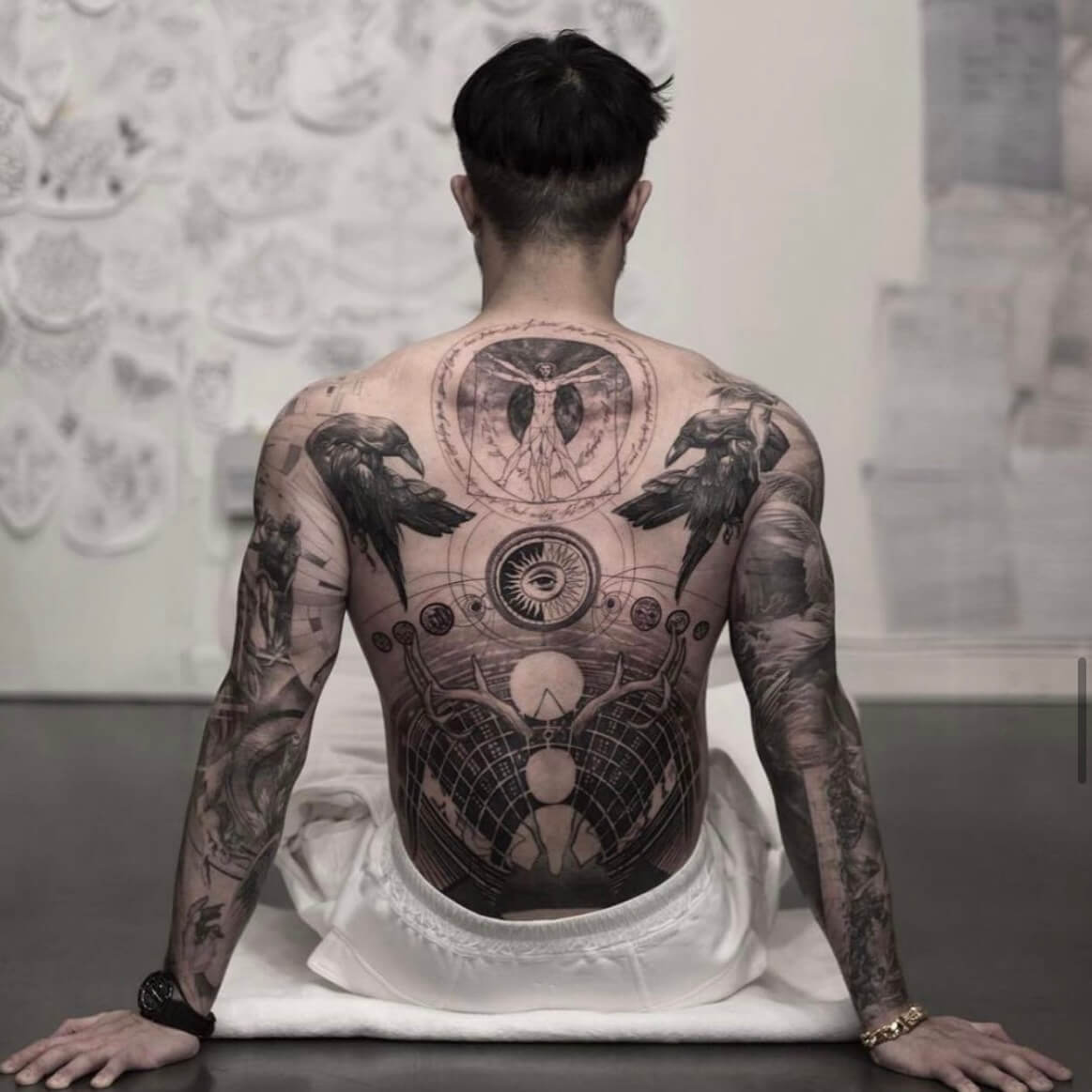
A full back tattoo extends from the top of the shoulders down to the lower back, treating the entire back as a unified composition. This is the most ambitious back tattoo commitment — full back pieces typically require multiple sessions spanning months and a coherent design plan from the start. The traditional Japanese irezumi back piece remains the archetype: a dragon, koi, phoenix, or mythological scene framed by clouds, waves, wind bars, and decorative elements that fill the entire back into a single unified image. Contemporary full back compositions also draw from religious imagery (cathedrals, archangels, religious scenes), large-scale realism portraits, dark blackwork compositions, and ornate ornamental and geometric arrangements.
Lower Back Tattoos
The lower back has been culturally rehabilitated over the past decade. After a period in which the lower back tattoo was reduced to a derogatory stereotype, contemporary lower back work — ornate, classy, meaningful pieces — has reclaimed the placement as a legitimate canvas for serious tattoo art. Modern lower back tattoo ideas include ornamental floral arrangements, mandala and geometric work, fine line botanical pieces, sacred geometry, lettering, and decorative spine extensions. The lower back ranks among the more sensitive placements pain-wise due to the proximity to the spine and lower lumbar area. Meaningful lower back tattoos for females currently lean strongly toward ornamental, fine line, and floral approaches over the older traditional and tribal styles.
Spine and Center Back
Spine tattoos are technically their own placement category, but spine work often functions as the structural anchor of larger back compositions. A vertical spine piece — lettering, ornamental linework, florals climbing the spine, or a sword along the spine — can stand alone or serve as the central axis around which a larger back tattoo is built. Spine placement is among the more painful back zones due to the direct bone proximity. See our dedicated spine tattoo ideas guide for deeper coverage of this placement.
Back of Neck and Nape
The back of the neck — the nape, just below the hairline — is technically part of the back tattoo zone and is often integrated with upper back work or treated as its own placement. Back neck tattoos are easy to cover with hair or collars, suit small symbolic pieces extremely well, and read powerfully on shaved or short-haired wearers. Common back neck designs include small symbols, single words or initials, minimalist religious imagery, and ornamental motifs that descend slightly toward the upper back.
Back Shoulder and Shoulder Blade
Back shoulder tattoos and shoulder blade tattoos cover the area from the top of the shoulder down across the scapula. This zone suits both standalone pieces — single florals, sacred geometry, small mandalas, decorative ornamental work — and integration with sleeve work extending down the arm. The shoulder blade is among the most flattering placements for women specifically, often chosen for floral arrangements, butterflies, and ornamental designs.
Half Back Tattoos
A half back tattoo covers either the upper or lower half of the back as a unified composition. This is a middle path between a standalone upper back piece and a full back commitment — large enough for ambitious compositions, smaller enough to complete in fewer sessions. Half back pieces often function as a first step that can later be extended into a full back composition if the wearer chooses to continue.
Most Popular Back Tattoo Designs by Theme
The back's scale makes it the most versatile placement for design themes, accommodating subjects that are too large or too compositionally complex for almost any other body area. Below are the most requested back tattoo design categories.
Japanese and Irezumi Back Tattoos
The Japanese back tattoo — particularly the traditional irezumi full back piece — is among the oldest and most refined back tattoo traditions in the world. Classic Japanese back compositions feature dragons (representing strength, wisdom, and protection), koi fish (perseverance and transformation), phoenixes (rebirth and resilience), samurai figures, oni masks, and tigers, all framed by traditional decorative elements: wind bars, finger waves, cherry blossoms, maple leaves, and clouds. The yakuza back tattoo tradition draws from the same visual vocabulary but carries specific cultural associations with Japanese organized crime — though the imagery itself is now widely practiced internationally as a legitimate tattoo style. Traditional Japanese back tattoos are typically executed over many sessions, with the unified composition planned from the outset. The Japanese dragon back tattoo and koi fish back tattoo remain among the most requested specific designs in this tradition. See our broader Japanese tattoo style guide for full coverage.
Angel Wings and Wings Back Tattoos
Angel wings tattoos on the back are among the most universally recognizable back tattoo designs. The full back angel wings composition — wings spanning shoulder blade to shoulder blade and extending down the back — creates one of the most dramatic visual statements available in tattooing. The symbolism is layered: angel wings represent protection, spiritual ascension, divine guardianship, memory of lost loved ones, or personal transformation. Fallen angel wings tattoos invert this symbolism toward themes of loss, rebellion, or moral complexity. Guardian angel wings back tattoos are frequently chosen as memorial pieces. Female angel wings tattoos on the back often lean toward more delicate feather rendering and fine line execution, while male angel wings compositions tend toward bolder, more dramatic feathering and darker contrast. Wings back tattoos in non-angel variations — bird wings, dragon wings, mechanical or steampunk wings — extend the same compositional logic into different aesthetic territories.
Religious Back Tattoos
Religious back tattoos function as devotional pieces, with the scale of the back providing the visual gravity these subjects traditionally require. The most requested religious back tattoo designs include Archangel Michael (traditionally depicted defeating Satan, a major symbol of spiritual protection), Saint Michael back tattoos with sword and armor, the Virgin Mary, Jesus portraits, the Crucifixion, cathedral imagery, and large back cross tattoos. The big cross tattoo on back — typically rendered with shading, halo elements, or surrounding banner work — remains one of the most enduring religious back tattoo choices. Christian back tattoos often pair these central figures with scripture lettering, ornamental framing, doves, or religious script. Santa Muerte back tattoos draw from Mexican folk Catholic tradition and carry their own iconographic conventions. For these large religious compositions, realism, black and grey realism, and traditional approaches all work effectively at the back's scale.
Dragon Back Tattoos
The dragon back tattoo is one of the most enduring single-subject back compositions in tattooing. Dragons translate exceptionally well to the back's scale and shape: the long serpentine body can climb the spine, wrap diagonally across the back, or fill the entire torso in a sweeping composition. Japanese dragon back tattoos draw from the irezumi tradition described above. Chinese dragon back tattoos often emphasize different proportions and stylistic conventions. Red dragon back tattoos and color dragon back tattoos lean into bold saturation, while black and grey realism dragon work emphasizes shadow and dimension. Dragon back tattoo female compositions frequently incorporate florals, cherry blossoms, or decorative framing to soften the imagery, while dragon back tattoo male variants tend toward darker tonal work and more aggressive postures. See our dragon tattoo guide for deeper coverage of dragon symbolism and styles.
Phoenix and Mythological Animal Back Tattoos
The phoenix back tattoo is among the most thematically resonant choices for a major back piece. The phoenix's symbolism — death, rebirth, transformation, rising from ashes — pairs naturally with the commitment of getting a back tattoo. Compositions typically feature the phoenix in full flight with wings spread across the back, flames at the base ascending into feathered form. Phoenix back tattoos for women often lean toward color-rich rendering with deep reds, oranges, and golds, while men's phoenix back compositions sometimes favor black and grey realism for a more dramatic shadow-based aesthetic. Other large mythological subjects suited to the back include griffins, hydra and serpent compositions, and traditional mythological scenes drawn from various cultural traditions.
Animal Back Tattoos
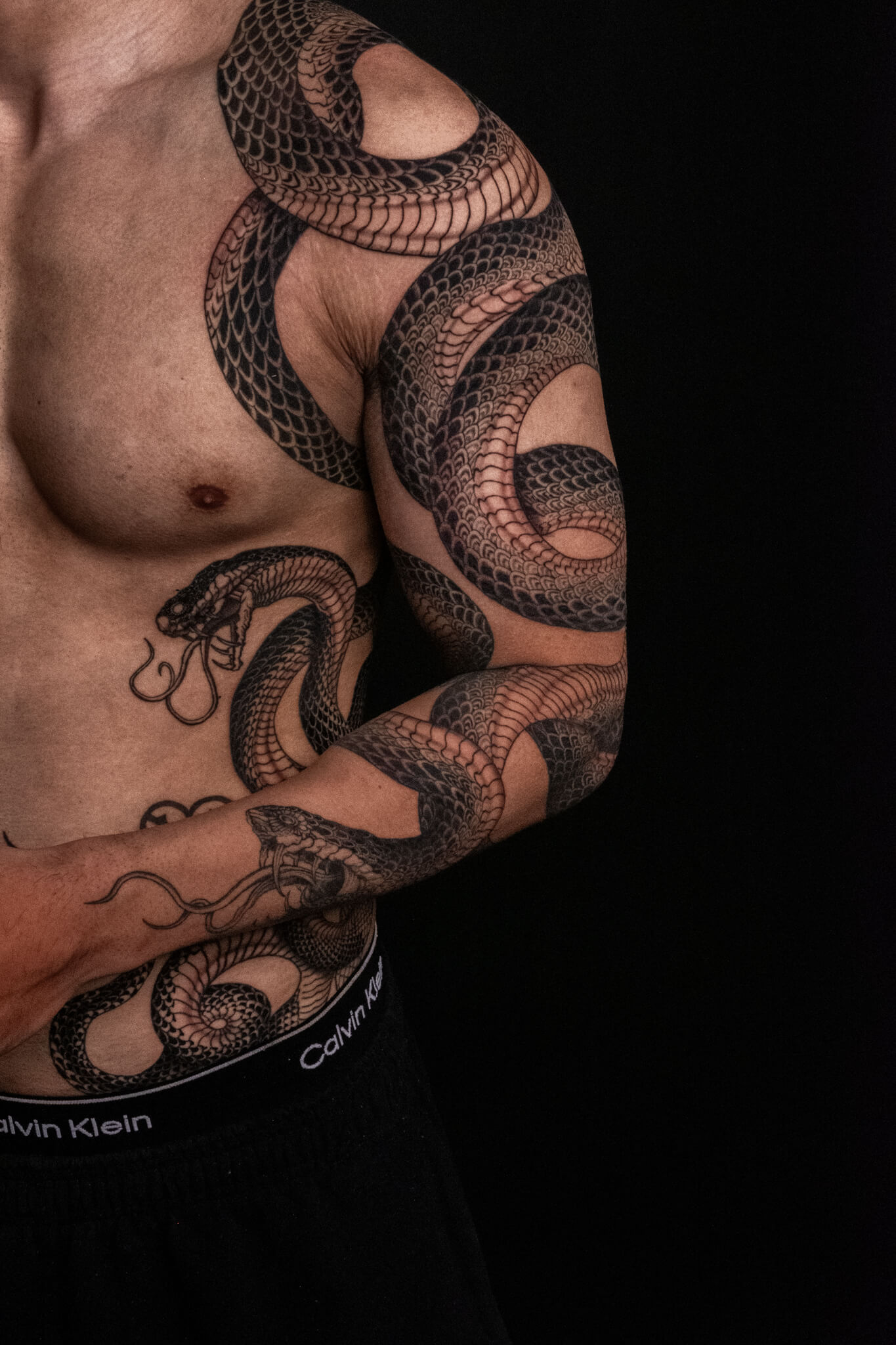
Beyond the mythological, the back accommodates large naturalistic animal compositions with exceptional clarity. Snake back tattoos work especially well — the serpentine form follows the spine or wraps diagonally, with options ranging from traditional snake and rose compositions to ornate Japanese-style serpents. See our snake tattoo guide for symbolism. Lion back tattoos and tiger back tattoos suit the upper back's broad canvas, often rendered in realism or black and grey realism for the texture of fur and intensity of expression. Wolf back tattoos, panther back tattoos, eagle back tattoos, raven back tattoos, and crow back tattoos each carry their own symbolic associations and visual character. Butterfly back tattoos remain the most requested female-leaning animal back choice — a single large butterfly between the shoulder blades, or a swarm composition across the upper back, both work effectively at this scale. See our butterfly tattoo guide for designs and meanings.
Floral and Botanical Back Tattoos
Floral back tattoos are among the most visually flexible back tattoo categories, working across virtually every style from photorealism to fine line. A back flower tattoo can be a single dramatic bloom centered between the shoulders, a cascading arrangement following the spine, or an ornate full back floral composition with vines, leaves, and decorative elements filling the entire canvas. Specific floral designs frequently chosen for the back include the rose back tattoo (traditional or fine line), the lotus flower back tattoo (spiritual symbolism, often paired with mandala work), the cherry blossom back tattoo (Japanese tradition), and the tree of life back tattoo (deep symbolic meaning, often executed with extensive root and branch detail). Floral back tattoos for women dominate this category, but men increasingly choose ornate floral back pieces in traditional or realism styles. Floral work at Monolith Studio is led by RK, whose botanical specialty informs detailed floral and nature compositions.
Geometric, Mandala, and Ornamental Back Tattoos
Geometric and ornamental back tattoos use the back's symmetrical shape as their fundamental compositional resource. Sacred geometry back compositions — interlocking shapes, mandala frameworks, dotwork constructions — center on the spine and expand outward across the upper back. Mandala back tattoos, often spanning from the back of the neck down to mid-back, draw from spiritual traditions of meditation and wholeness while functioning as some of the most visually arresting back compositions available. Ornamental back tattoos blend decorative elements — lacework, jewelry-inspired chains, filigree, dotwork shading — into pieces that read as wearable adornment. Geometric tattoo work at Monolith is led by Okan Uckun and Denizhan Ozkar, while mandala work is the specialty of George Kalodimas. See our geometric tattoo guide and ornamental tattoo guide for fuller coverage.
Dark and Mythological Back Tattoos
Dark back tattoos lean into heavy black saturation, gothic atmosphere, and mythological imagery. Skull back tattoos — sometimes a single large skull centered on the upper back, sometimes incorporated into larger compositions with wings, daggers, or roses — anchor this category. Grim reaper back tattoos and reaper back tattoos extend the death symbolism into figurative work, often with extensive cloak and scythe detail. Medusa back tattoos have surged in popularity, drawing from Greek mythology and contemporary feminist reinterpretation of the Medusa figure as a symbol of survival and reclaimed power. Icarus back tattoos reference the Greek myth of ascension and tragic failure — wings spreading toward a sun, with the figure caught in the moment of flight or fall. Demon back tattoos, devil back tattoos, and skeleton back tattoos all extend this dark mythological tradition. Blackwork and dark ornamental approaches work especially powerfully at the back's scale, where dense black areas create genuine visual gravity. See our skull tattoo ideas guide for related coverage.
Style-Led Back Tattoos
Several back tattoo designs are defined less by their subject matter and more by the visual style they inhabit. Fine line back tattoos use single-needle precision for delicate compositions — botanical pieces, minimalist symbols, fine script, and ornate decorative work executed at exceptional detail. Cyber sigilism back tattoos are among the fastest-rising contemporary styles — sharp Y2K-inflected linework, occult symbolic vocabulary, decorative tribal references, and bold geometric extensions. Traditional back tattoos and American traditional back tattoos draw from old-school flash with bold outlines, classic compositions, and timeless visual readability. Tribal back tattoos in modern blackwork interpretations have moved beyond their early-2000s stereotype into more sophisticated decorative work. Anime back tattoos draw from manga and anime imagery, often executed in detailed black and grey or color realism. Viking back tattoos, henna back tattoos, sak yant back tattoos, and Thai back tattoos each reference specific cultural traditions with their own iconographic conventions.
Lettering and Name Back Tattoos
Lettering back tattoos focus on text as the primary subject. The last name back tattoo — typically rendered in large script across the upper back — has become one of the most enduring back tattoo categories, often chosen as a tribute to family or as a statement of identity. Other lettering back tattoo approaches include long script passages (poetry, scripture, personal mantras) running down the spine, single powerful words across the upper back, and family name pieces incorporating decorative elements like banners or florals. Script-based lettering back tattoos require careful planning around aging — fine lines tend to soften over decades, so larger, well-spaced lettering generally ages better than dense small text.
Back Tattoo Ideas for Men
Back tattoo ideas for men trend toward bold compositional weight, larger-scale work, and themes that emphasize strength, lineage, spiritual conviction, or cultural identity. The most requested back tattoo concepts for men include religious imagery (Archangel Michael, large cross compositions, the Crucifixion), Japanese irezumi pieces (dragons, koi, samurai, oni), large-scale realism portraits, mythological figures (phoenix, lion, tiger, wolf), large lettering and family name work, and dark blackwork compositions. Upper back tattoos for men typically focus on the area between the shoulder blades — spanning from shoulder to shoulder with a single dramatic image. Men's back tattoo placements often extend the back work into sleeve compositions, with the back piece serving as the anchor of a larger body-spanning project. Masculine back neck tattoos for men frequently feature single powerful symbols, religious imagery in smaller scale, or lettering that complements a larger upper back composition. Simple back tattoos for men can also be highly effective — a single fine line piece, a small symbolic image, or a minimalist family name in script — for collectors who want a meaningful back tattoo without the commitment of large-scale work.
Back Tattoo Ideas for Women
Back tattoo ideas for women span a far wider range than the older stereotypes suggest. The most requested back tattoo concepts for women include angel wings (full back or upper back), ornate floral arrangements, mandala and geometric work, butterfly and moth compositions, fine line botanical pieces, religious imagery (particularly the Virgin Mary and saints in delicate realism), phoenix in color work, and ornamental spine decorations. Classy full back tattoos for women lean into ornate decorative work — fine line florals, mandala framings, lacework-style ornamentation — that reads as wearable adornment rather than purely figurative imagery. Beautiful back tattoos for females in current trends emphasize fine line precision, delicate shading, and ornamental detail over the bolder traditional approaches that dominated earlier decades. Lower back tattoos for women have been fully reclaimed by contemporary tattooing — meaningful lower back tattoos in ornamental, geometric, or fine line styles have replaced the stereotyped tribal designs of an earlier era. Cute back tattoos for females, small back tattoos for women, and feminine back tattoos generally favor placements like the upper shoulder blade, behind the neck, or along the spine for smaller pieces that can complement potential larger work later. Floral back compositions and botanical work at Monolith Studio are led by RK, whose specialty in detailed botanical pieces shapes much of the studio's floral back work.
Back Tattoo Pain: How Much Does a Back Tattoo Hurt?
The back is a large enough placement that pain varies significantly depending on which specific zone is being tattooed. Understanding the pain profile of different back areas helps with realistic session planning, especially for larger compositions that span multiple zones. The upper back over the shoulder blades is among the more tolerable back placements — muscle and fat covering the underlying bone make this area significantly more comfortable than thinner-skinned regions. The mid-back along the latissimus muscles is similarly manageable for most collectors. The spine itself is among the more painful back zones — direct bone proximity, dense nerve concentration, and minimal soft tissue all contribute to elevated sensitivity. The lower back ranks similarly painful, particularly along the lumbar spine. The back of the neck and nape area is moderately painful, with the thin skin and proximity to the cervical spine creating more intensity than the upper back proper. Sides of the back near the rib cage extend into one of the more painful body zones overall. Pain is also affected by session length: a full back composition spanning many hours becomes cumulatively more challenging than the same area tattooed in shorter, distributed sessions. Most experienced artists pace longer back sessions to allow for breaks, food, and recovery between extended periods of work. See our tattoo pain chart by placement guide for a fuller comparison across the body.
How Long Does a Back Tattoo Take to Heal?
Back tattoos generally take between two and four weeks for surface healing, with full deep tissue healing extending to three to six months depending on the size and density of the piece. The back is one of the more difficult placements to care for during healing because of its position: it is hard to see, hard to reach for self-application of aftercare, and constantly in contact with clothing, bedding, and chair backs. Practical considerations during healing include sleeping on your stomach or side rather than your back, wearing loose clothing that does not rub or stick to the fresh tattoo, and arranging for help with cleaning and moisturizing during the first week when the area is most sensitive. Larger back compositions executed over multiple sessions follow the same healing timeline for each individual session, with the artist generally allowing four to six weeks between sessions to ensure each area has healed sufficiently before the next round of work.
How Much Does a Back Tattoo Cost?
Back tattoo pricing varies enormously based on size, design complexity, color requirements, artist seniority, and total session count — there is no universal back tattoo cost. The factors that most directly influence pricing include the total surface area being tattooed (upper back versus full back represents a major scope difference), the level of detail and density of the design (a fine line piece and a full color realism composition occupying the same area can differ substantially in time required), the number of sessions needed to complete the work, and the studio's hourly or session-based pricing structure. Full back compositions are typically scoped and priced as a complete project rather than per session, with the total estimate provided after the consultation and design phase. At Monolith Studio, each artist sets their own pricing structure, and pricing is discussed transparently during the initial consultation once the design scope and session plan have been confirmed. The most reliable approach to back tattoo budgeting is to book a consultation with your chosen artist, discuss the full design vision, and receive a project-specific estimate based on the actual scope of what you want to create.
Preparing for Your Back Tattoo Session
Preparation matters more for back sessions than for almost any other placement because of the session length and physical demand involved. Practical preparation includes eating a substantial meal before your appointment (low blood sugar makes long sessions significantly harder to tolerate), staying well-hydrated in the days leading up to the session, avoiding alcohol for at least 24 hours before tattooing (alcohol thins the blood and affects ink retention), and getting adequate sleep the night before. Clothing matters specifically for back sessions: wear something easy to remove or roll down without disturbing the work area, and bring a clean loose layer to put on afterward that will not rub against the freshly tattooed skin. Long sessions benefit from bringing water, light snacks for breaks, and entertainment (headphones, audiobook, podcast) to occupy the mind during the work. For first back tattoos, particularly larger compositions, it can be useful to break the project into shorter introductory sessions to gauge personal pain tolerance and stamina before committing to longer single-session work.
Back Tattoo Studio in Brooklyn, NYC — Monolith Studio
Monolith Studio is a tattoo studio located at 77 Washington Avenue, Brooklyn, NYC 11205, with a team of internationally recognized artists working across geometric, fine line, realism, blackwork, ornamental, floral, and traditional styles. Back tattoo commissions at Monolith are fully custom — designed from scratch around your specific concept, placement zone, and aesthetic preferences, with a consultation phase that maps out the full composition before any work begins. Geometric and sacred geometry back pieces are led by Okan Uckun and Denizhan Ozkar. Mandala and ornate decorative back tattoos are the specialty of George Kalodimas. Floral and botanical back compositions are handled by RK. Realism back tattoos — portraits, religious imagery, large-scale detailed work — are led by Stevo, Oksu, and DIM.
For related guides, see our Japanese tattoo style guide, geometric tattoo guide, fine line tattoo guide, realism tattoo guide, blackwork tattoo guide, and ornamental tattoo guide. For related blog content, see our skull tattoo ideas, dragon tattoo guide, snake tattoo meaning, butterfly tattoo guide, tattoo sleeve ideas, and tattoo pain chart. Browse our complete tattoo styles collection or book your consultation to begin designing your back tattoo.

.avif)