
Dragon Tattoo Meaning
The dragon is one of the oldest and most universally recognized mythological creatures on earth — appearing independently in cultures across Asia, Europe, and the Middle East. Despite geographical distance, these traditions share a core set of associations: power, wisdom, protection, transformation, and a force that transcends ordinary human experience.
Understanding dragon tattoo meaning requires understanding which tradition you're drawing from, as the symbolism varies significantly.
Japanese Dragon Tattoo Meaning
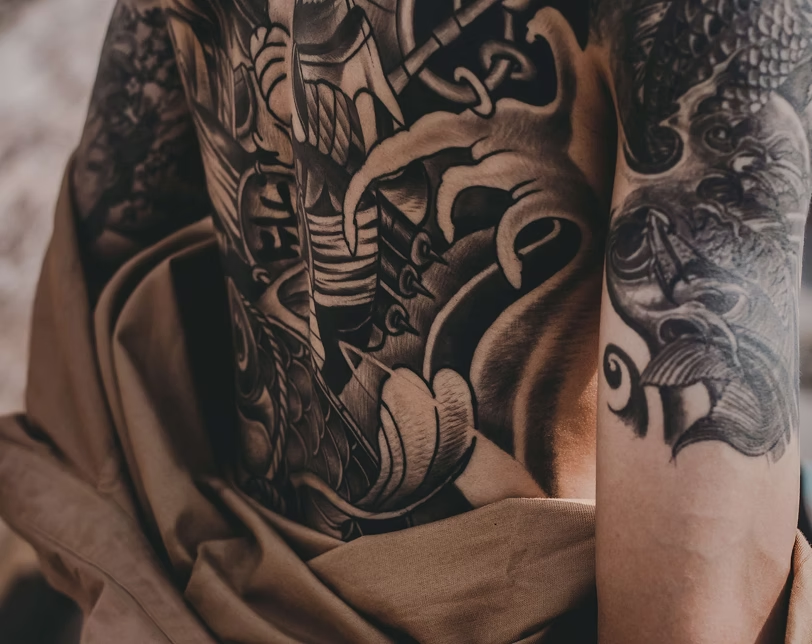
In Japanese tradition, the dragon (Ryu) is a fundamentally benevolent creature — a water deity associated with rain, rivers, and the ocean. Japanese dragons are wingless, serpentine, and deeply wise. They are protectors rather than destroyers, associated with good fortune, strength, and balance. A Japanese dragon tattoo draws on this symbolism: wisdom, protection, power used in service of good.
The Japanese dragon is one of the most iconic subjects in irezumi — traditional Japanese tattooing — and remains among the most requested dragon designs today. The flowing, serpentine form lends itself beautifully to sleeve compositions, back pieces, and large-scale work.
Chinese Dragon Tattoo Meaning
Chinese dragons (Long) share many qualities with their Japanese counterparts — they are similarly associated with water, wisdom, and imperial power. In Chinese tradition, the dragon is one of the four sacred creatures and represents the Emperor himself. A Chinese dragon tattoo carries connotations of authority, luck, and cosmic power.
Western Dragon Tattoo Meaning
Western dragons — the fire-breathing, winged creatures of European mythology — carry a different symbolic weight. They are often cast as adversaries: hoarding treasure, threatening kingdoms, to be slain by heroes. But they also represent primal power, ancient wisdom, and the untameable forces of nature. A Western dragon tattoo can symbolize strength, ferocity, and a refusal to be controlled.
Dragon Tattoo Meaning Across Traditions
Regardless of cultural origin, dragon tattoos commonly symbolize: power and strength, wisdom and longevity, protection, transformation and rebirth, duality (the capacity for both destruction and creation), and freedom from constraint. Many collectors choose dragon tattoos to represent a personal connection to these qualities — a strength they've cultivated, a transformation they've undergone, or a power they aspire to carry.
Dragon Tattoo Ideas and Styles
The dragon subject is one of the most flexible in tattooing — it can be executed in almost any style and at almost any scale, from a small minimalist outline to a full back piece. Here are the strongest directions:
Japanese Dragon Tattoo
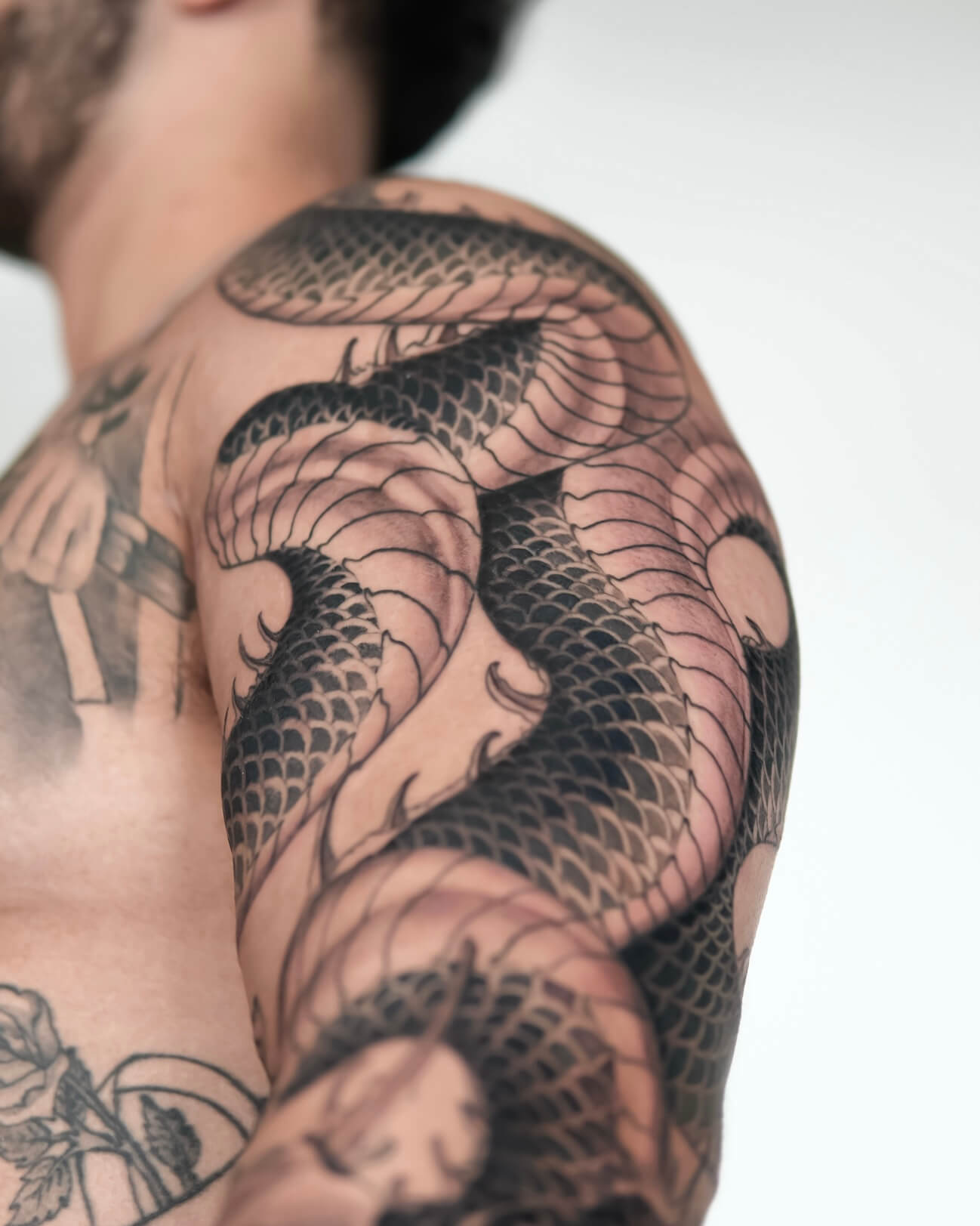
The Japanese dragon in irezumi style — flowing serpentine body, wisps of cloud and water, traditionally rendered in bold lines and rich color or dramatic black and grey — is one of the most iconic tattoo designs in history. At Monolith Studio, contemporary Japanese-influenced dragon work tends toward more refined, fine line interpretations that honor the tradition while feeling completely current.
Fine Line Dragon Tattoo
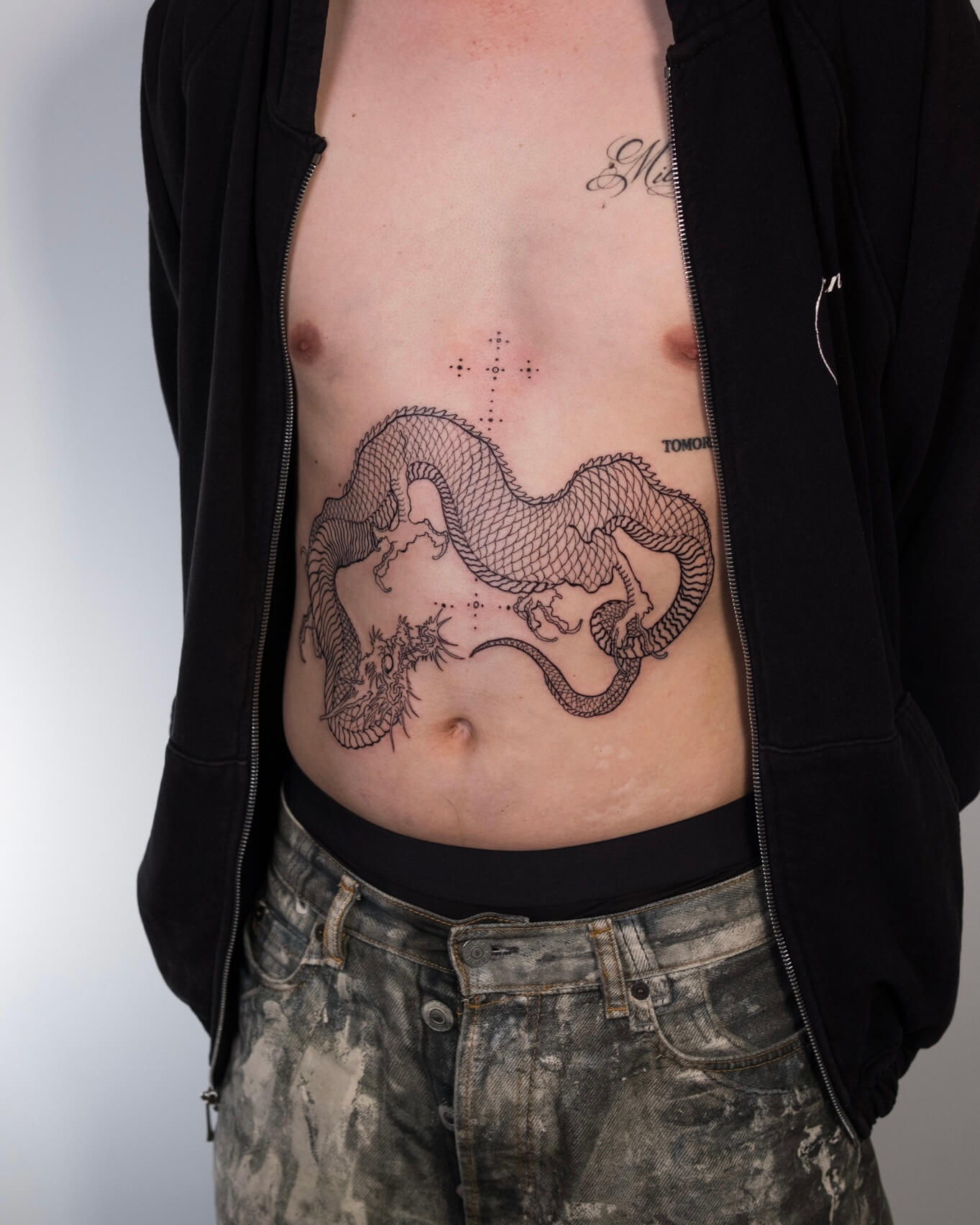
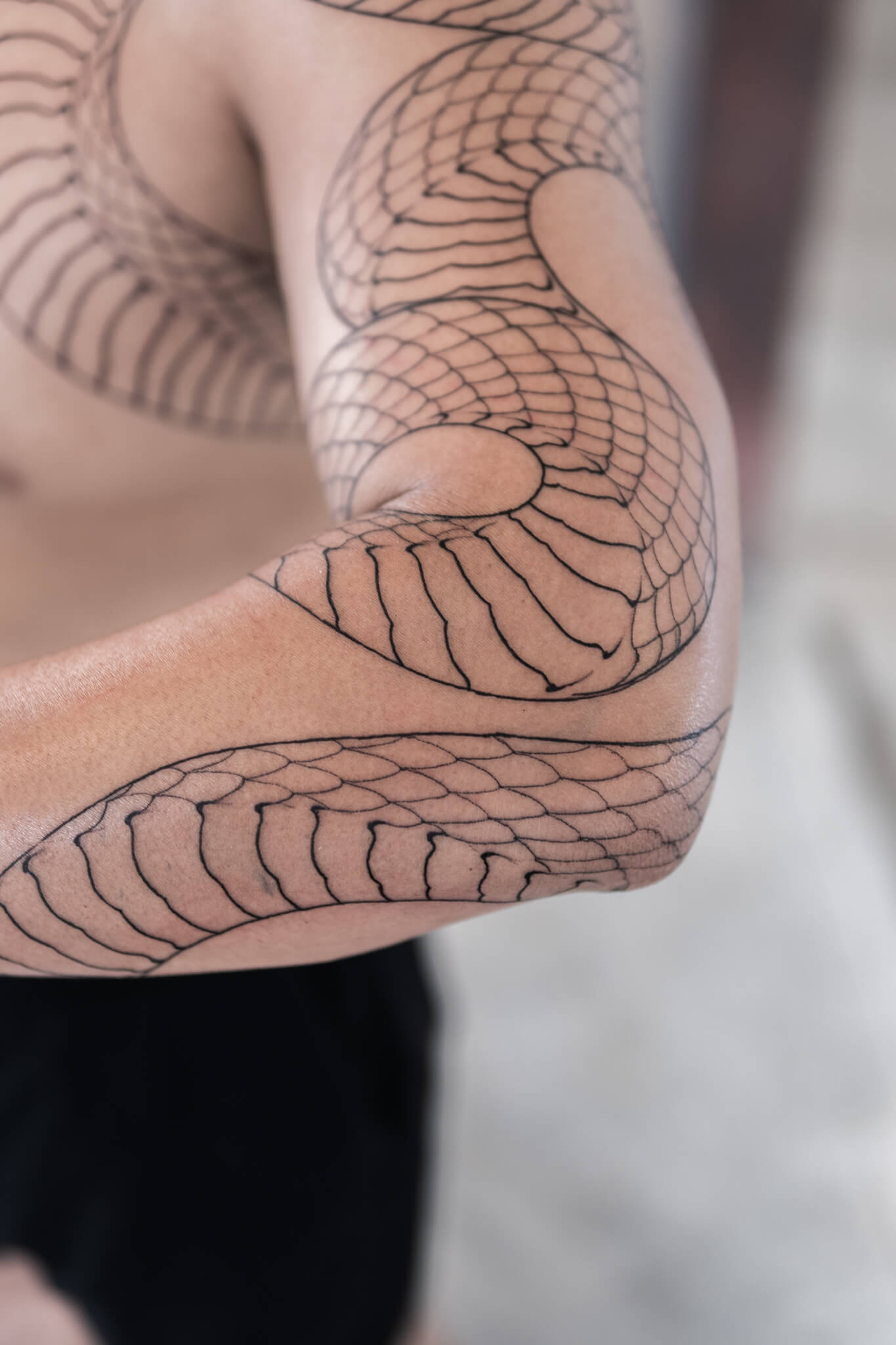
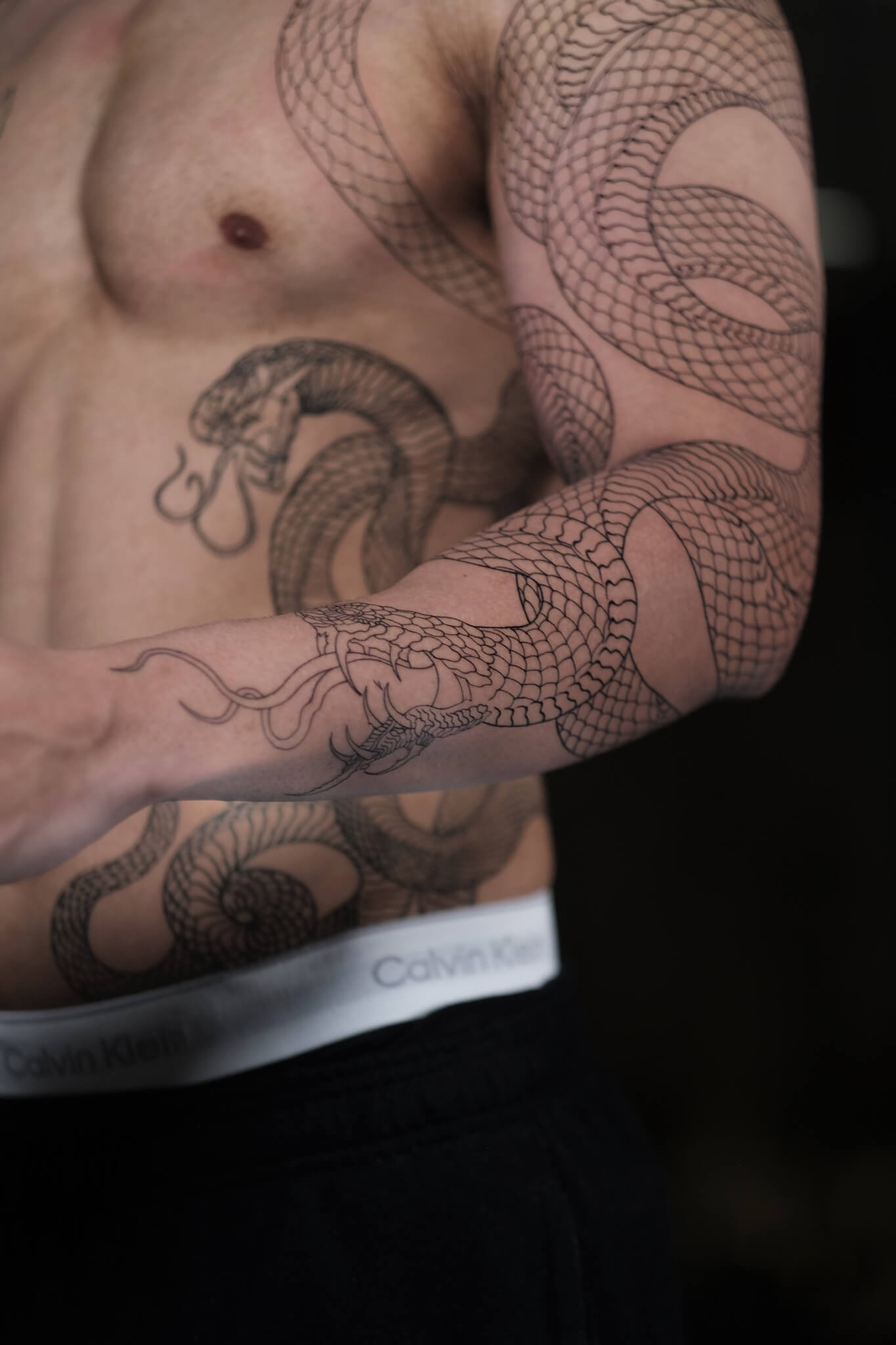
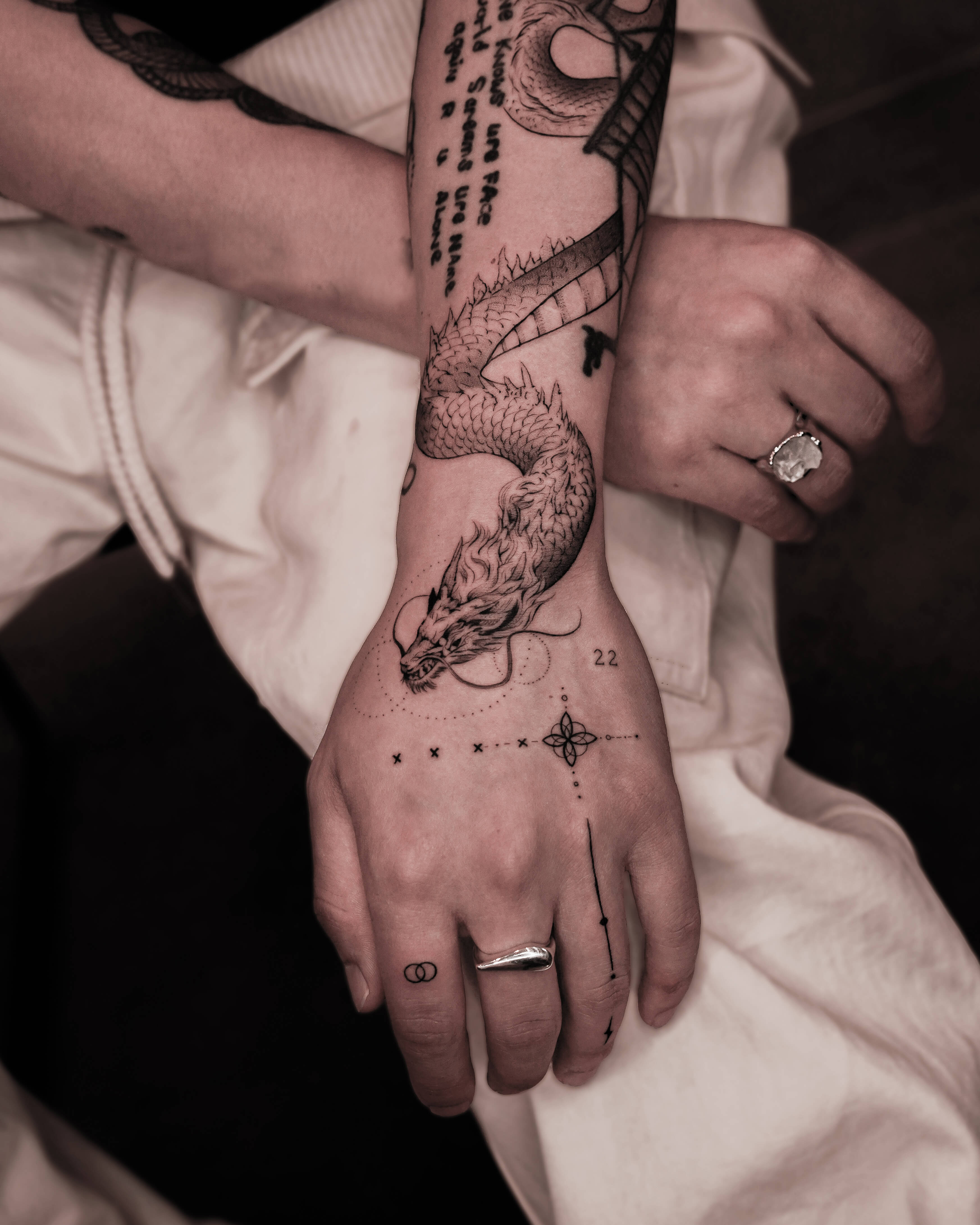
A fine line dragon renders the creature with a delicacy that transforms it from a bold traditional subject into something that feels like illustration. The scales, the expression, the sinuous movement of the body — all captured in precise, thin linework. Fine line dragon tattoos are particularly striking on the forearm, where the length of the design can flow naturally along the arm.
Traditional Dragon Tattoo
The American traditional dragon — bold outlines, limited color palette, clean iconic shapes — is a timeless interpretation. These designs hold up exceptionally well over time and have an immediate visual impact that more detailed styles can't always achieve at smaller scales.
Simple Dragon Tattoo
A minimalist or simple dragon reduces the creature to its essential form — a single line suggesting the body's curve, a minimal outline of the head and scales. These designs carry enormous symbolic weight in a small, clean package. Simple dragon tattoos are among the most requested minimalist subjects at Monolith Studio.
Dragon Back Tattoo
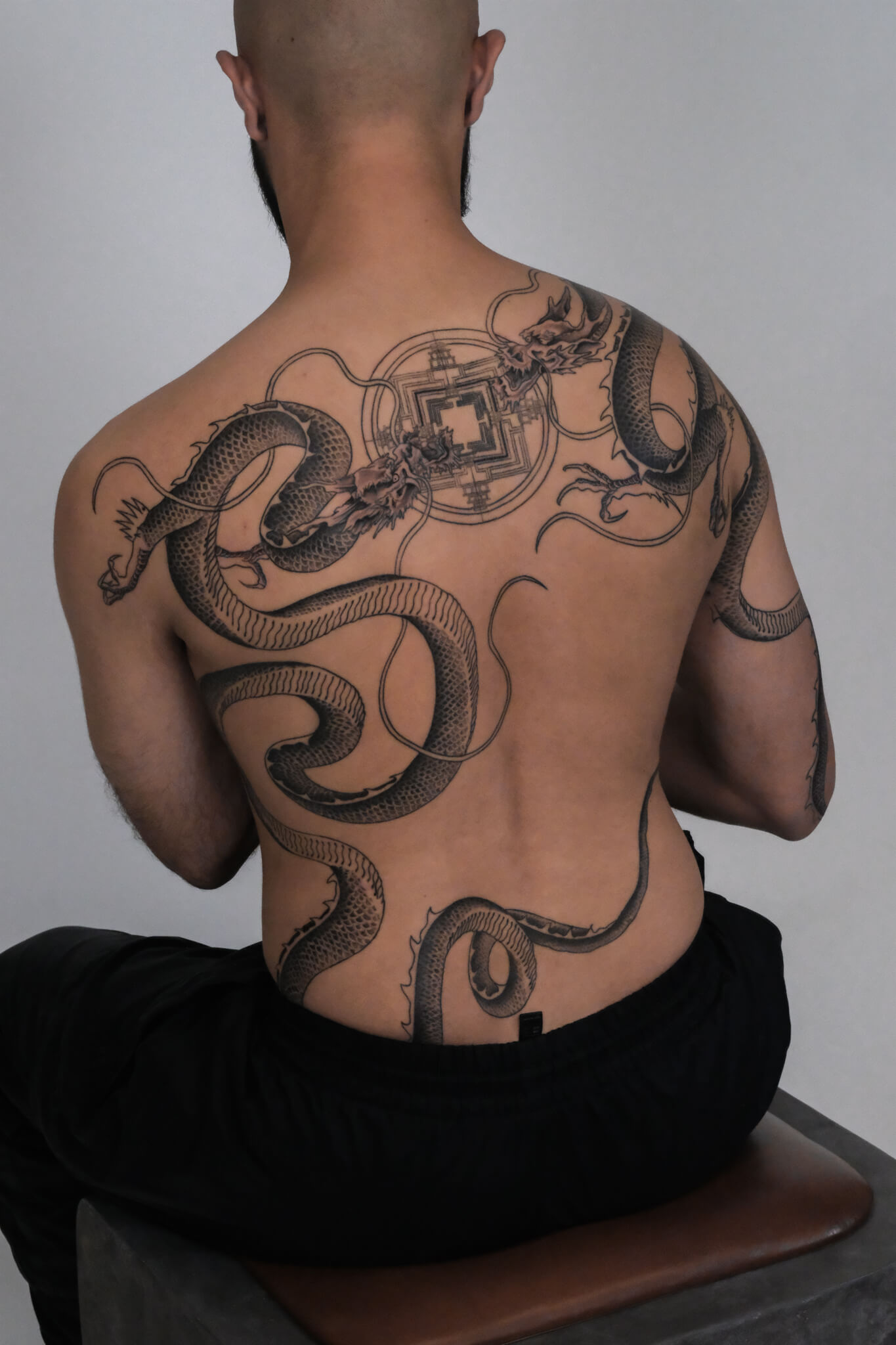
The back provides the ideal canvas for an ambitious dragon composition. A full back dragon — coiling across the entire back, head at the shoulder and tail at the lower back — is one of the most visually powerful tattoo compositions possible. These pieces typically require multiple sessions and a deep collaboration between artist and collector to execute well.
Dragon Tattoo Sleeve
A dragon sleeve — wrapping the creature around the entire arm from shoulder to wrist — is a natural format for the dragon's serpentine form. Our tattoo sleeve guide covers the planning process for large-scale compositions like this.
Geometric Dragon Tattoo
Combining the dragon with geometric elements — sacred geometry, angular fragmentation, symmetrical framing — creates a striking contemporary interpretation. The contrast between the organic, mythological creature and the mathematical precision of geometric forms produces a uniquely powerful visual tension.

Dragon Tattoo Placement Guide
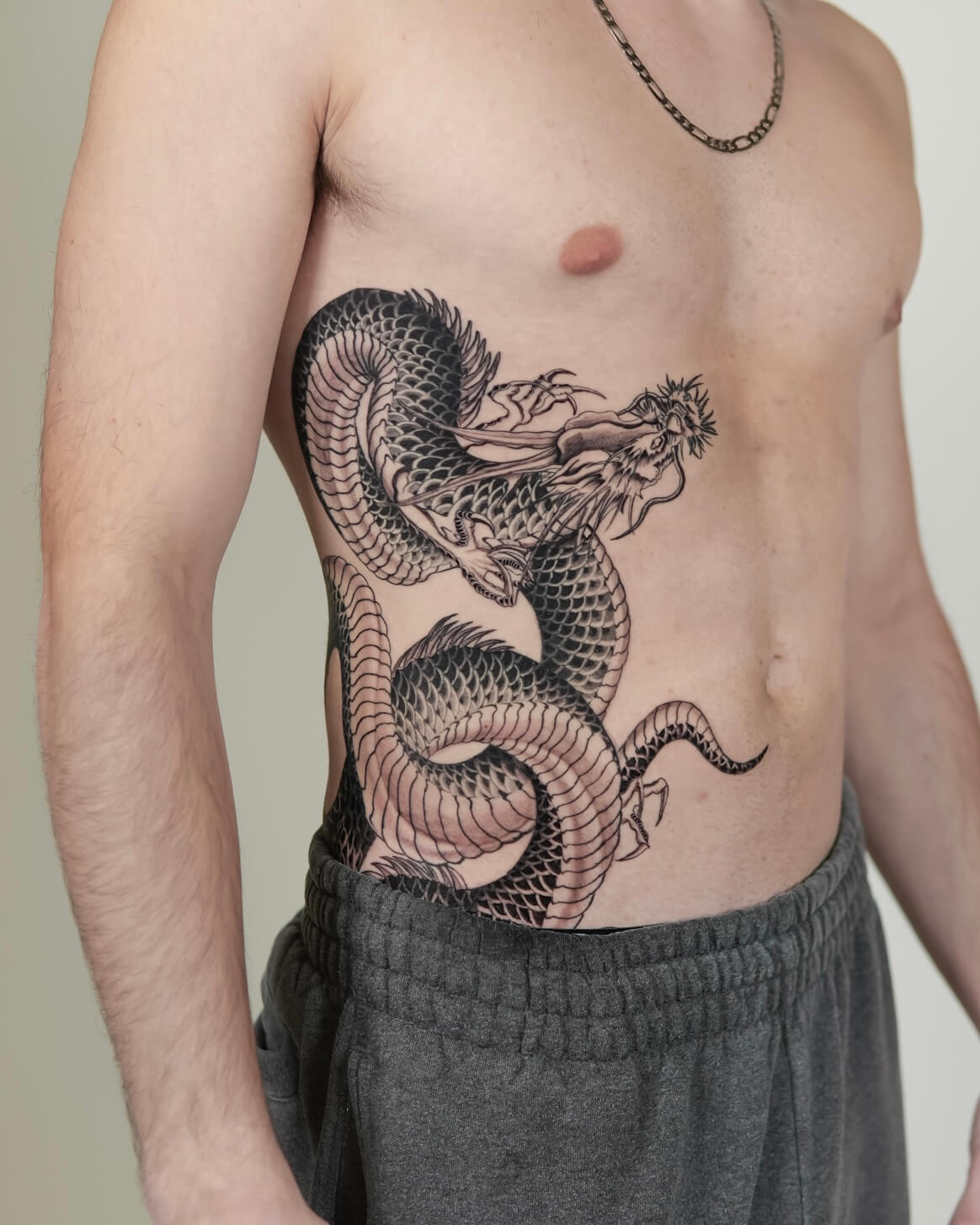
The dragon's serpentine form gives it extraordinary flexibility in placement — it can flow along the natural lines of the body in ways that few other subjects can.
Back: The definitive dragon placement for large-scale work. Full back pieces allow for the full mythology to unfold — clouds, waves, and the complete creature rendered in extraordinary detail.
Sleeve: The arm's cylindrical shape mirrors the dragon's coiling body perfectly. Dragon sleeves feel like the creature is wrapped around the arm — alive, moving, protective.
Forearm: A shorter dragon composition — head at the wrist, body flowing toward the elbow — makes a bold statement on a visible, accessible placement.
Chest: A dragon spread across the chest and shoulders — wings extended, head at the center — is one of the most powerful chest tattoo compositions.
Thigh: The thigh provides ample canvas for a large, detailed dragon without the full commitment of a sleeve or back piece.
Spine: A dragon running down the spine — head at the neck, tail at the lower back — is a striking and visually coherent placement that honors the dragon's serpentine form.
Dragon Tattoo Ideas for Men
Dragon tattoos for men often lean toward the dramatic and large-scale — back pieces, sleeves, and chest compositions that showcase the creature's full power. Japanese dragon sleeves, black and grey realism back pieces, and bold traditional chest tattoos are among the most popular directions. The dragon's associations with strength, wisdom, and protection resonate particularly strongly for collectors who want body art that makes an unambiguous statement of presence.
Dragon Tattoo Ideas for Women
Women's dragon tattoos have become increasingly popular and increasingly diverse in interpretation. Fine line dragons, minimalist dragon outlines, geometric dragon compositions, and delicate dragons incorporated into larger botanical or ornamental designs are all strong directions. Many female collectors are drawn to the Japanese dragon's associations with wisdom and protection rather than the Western dragon's more aggressive connotations.
Dragon Tattoos at Monolith Studio — Brooklyn, NYC
At Monolith Studio in Brooklyn, NYC, dragon tattoos are among our most ambitious and visually rewarding commissions. Our artists approach the dragon subject with deep respect for the traditions it draws from and the technical demands it places on the execution.
Located at 77 Washington Avenue, Brooklyn, NYC 11205, Monolith specializes in styles that translate powerfully to the dragon subject:
For fine line and micro realism dragon work: Oscar Akermo, Oksu, and the Monolith fine line team bring exceptional precision to scale and anatomical detail.
For geometric dragon compositions: Okan Uckun and Denizhan Ozkar create dragon pieces that fuse mythological iconography with mathematical precision.
For large-scale back pieces and sleeves: Monolith's artists with extensive experience in Japanese-influenced and blackwork traditions execute full-scale dragon compositions that command the body's full canvas.
For serpentine and dragon-specific work: Corey Gonzales and JZ bring a distinctive approach to dragon subjects — combining precise linework with a deep understanding of serpentine form and movement.
For placement advice, design consultation, and booking: submit a consultation request at Monolith Studio.
Dragon Tattoo at Monolith Studio Brooklyn
Monolith Studio in Brooklyn executes dragon tattoos across every style — Japanese-influenced irezumi dragons in realism and blackwork, Western dragons in American traditional, minimalist dragon silhouettes in fine line. Located at 77 Washington Avenue, Brooklyn, NYC 11205.
For related symbolism in tattooing, see our snake tattoo guide and ouroboros tattoo guide. Browse all tattoo styles or book your consultation.