


What Was the Renaissance?
Renaissance is French for rebirth. The word describes the culture of Italy from about the 14th to the 16th century, and in art the story usually starts in Florence around 1400, when artists and scholars went back to ancient Greece and Rome and painting changed for good.
Old Books, New Eyes
The big idea was humanism: recover ancient Greek and Roman writing and learn from it. That didn't push religion aside. Most humanists stayed religious, and around 1510 Raphael painted Plato and Aristotle, two pagan thinkers, on a wall in the Vatican for Pope Julius II. That fresco, The School of Athens, is the image at the top of this page. Plato and Aristotle are the two men walking toward you under the arch.
Artists Started Working Things Out
Painters stopped guessing. Brunelleschi cracked linear perspective in Florence and Alberti wrote it down in the 1430s. In Masaccio's Holy Trinity, from around 1427, a flat church wall turns into a deep vaulted chapel. Leonardo said he had dissected more than 30 bodies, and he drew what he found. The young Michelangelo dissected in Florence too. Muscle stopped being guesswork.
Who Paid for It
The Medici bank opened in 1397, and the family's money fed the art of Florence. In 1459 Piero de' Medici hired Benozzo Gozzoli to paint the family chapel, and Piero and his father Cosimo appear in the fresco, riding in the procession. Popes were just as keen. Art had become a way to show power.
From High Renaissance to Mannerism
Masaccio and Botticelli belong to the early period. The High Renaissance, roughly the 1490s to the 1520s, is the time of Leonardo, Michelangelo and Raphael, and it gave us many of the images people now ask for. Around 1520 the calm started to crack. Mannerism stretched bodies and crowded the frame, and in 1527 Rome was sacked. Pontormo's Deposition, finished around 1528, has no landscape at all, only figures.
North of the Alps
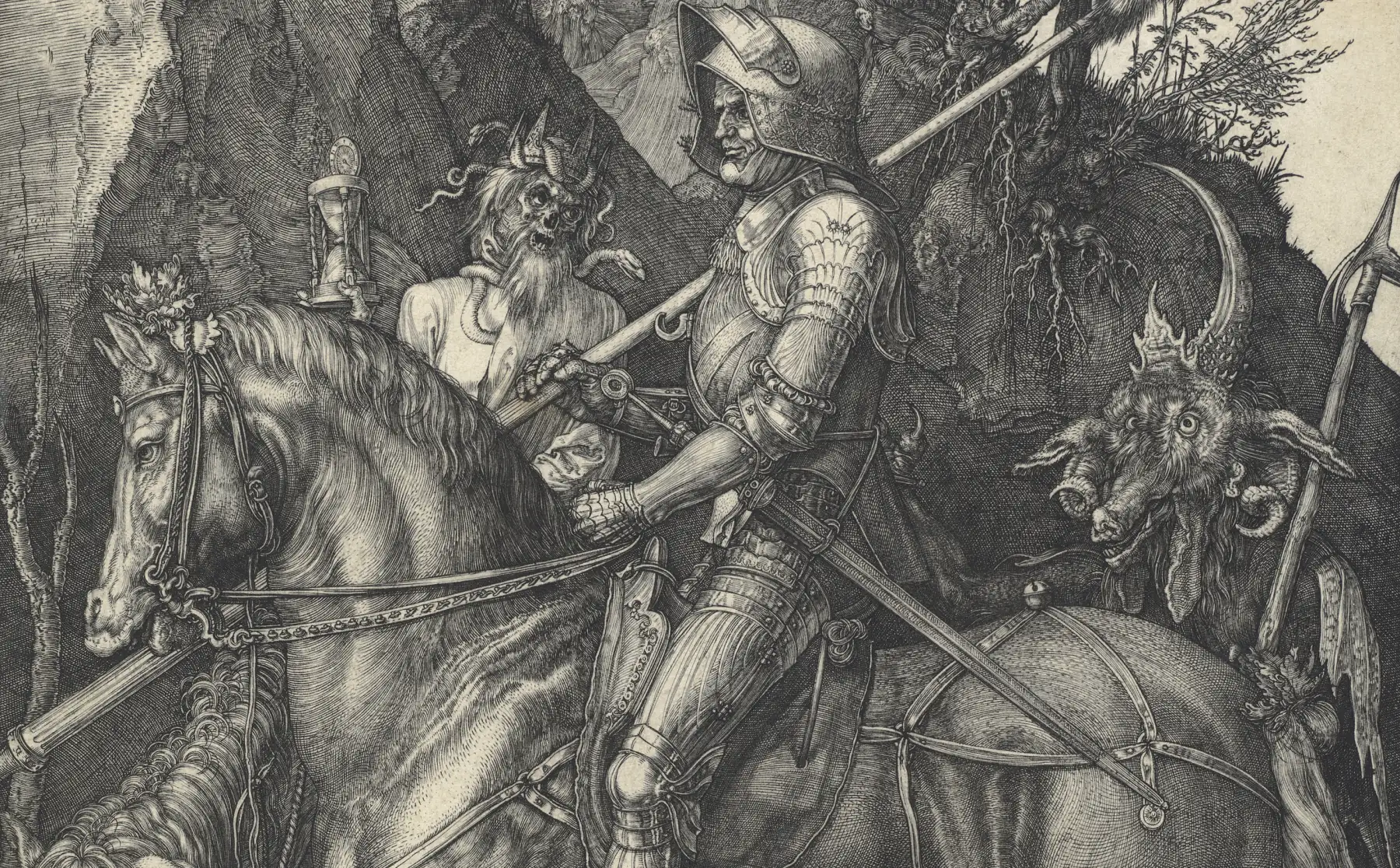
Albrecht Dürer of Nuremberg worked in Venice in 1506 and took Italian ideas home. His engraving Knight, Death and the Devil, from 1513, is shown below. It is nothing but black lines on paper, yet dots, curves and cross-hatching build a full range of greys. Keep that in mind for later.
Renaissance Principles and How They Show in Tattoos
Skin is flat, and a good tattoo doesn't look it. Renaissance painters spent their lives on that same problem: how do you make depth on a flat surface? To be clear, black and grey tattooing has its own history. It grew out of Chicano tattooing in Southern California, and our black and grey realism guide covers that story. What connects the two is the problem, not a family tree. Knowing these eight principles makes it easier to tell an artist what you want, and to see why one piece lifts off the arm while another sits flat.
1. Chiaroscuro: Light Builds the Form
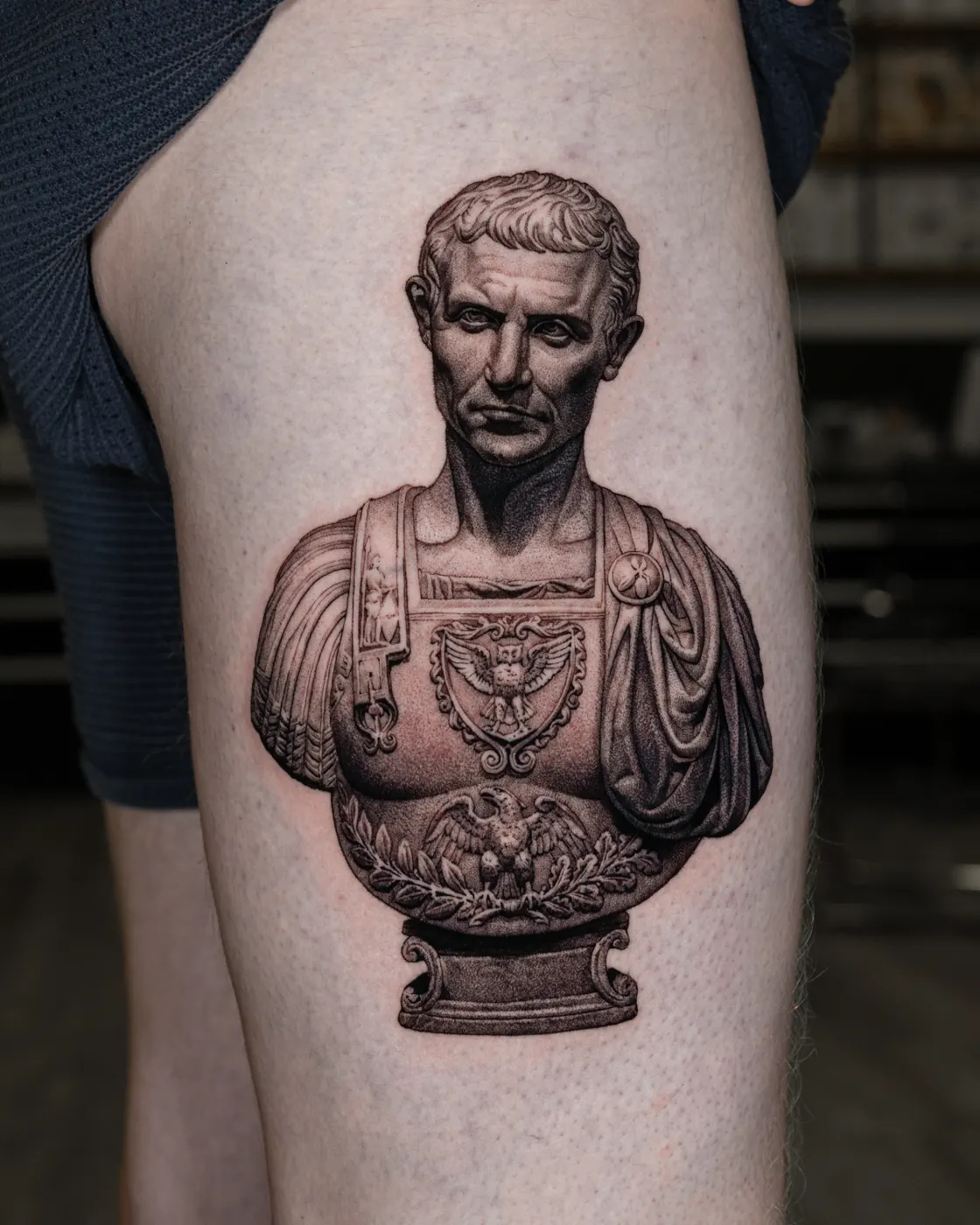
Chiaroscuro is Italian for light-dark. Clear tonal contrast makes a flat surface look round, and Leonardo used it to give his figures volume, as in Lady with an Ermine from around 1490. In a tattoo it means choosing where the light falls and letting the form turn from bright skin into deep shadow. That's why Oksu's bust, the first image below, looks carved from stone rather than drawn on skin.
2. Sfumato: Soft Edges Do the Work
Sfumato means smoked: outlines melt into shadow. In 2010, X-ray research on the Mona Lisa showed how Leonardo did it, with glazes just one to two thousandths of a millimeter thick, layered up. A tattoo artist gets a similar softness with smooth, gradual shading built over several passes. Skin behaves like paint here, and a hard line around a cheek flattens it straight away. In Stevo's portrait, second below, the face slides into the dark with no outline at all.
3. Contrapposto: Weight on One Leg
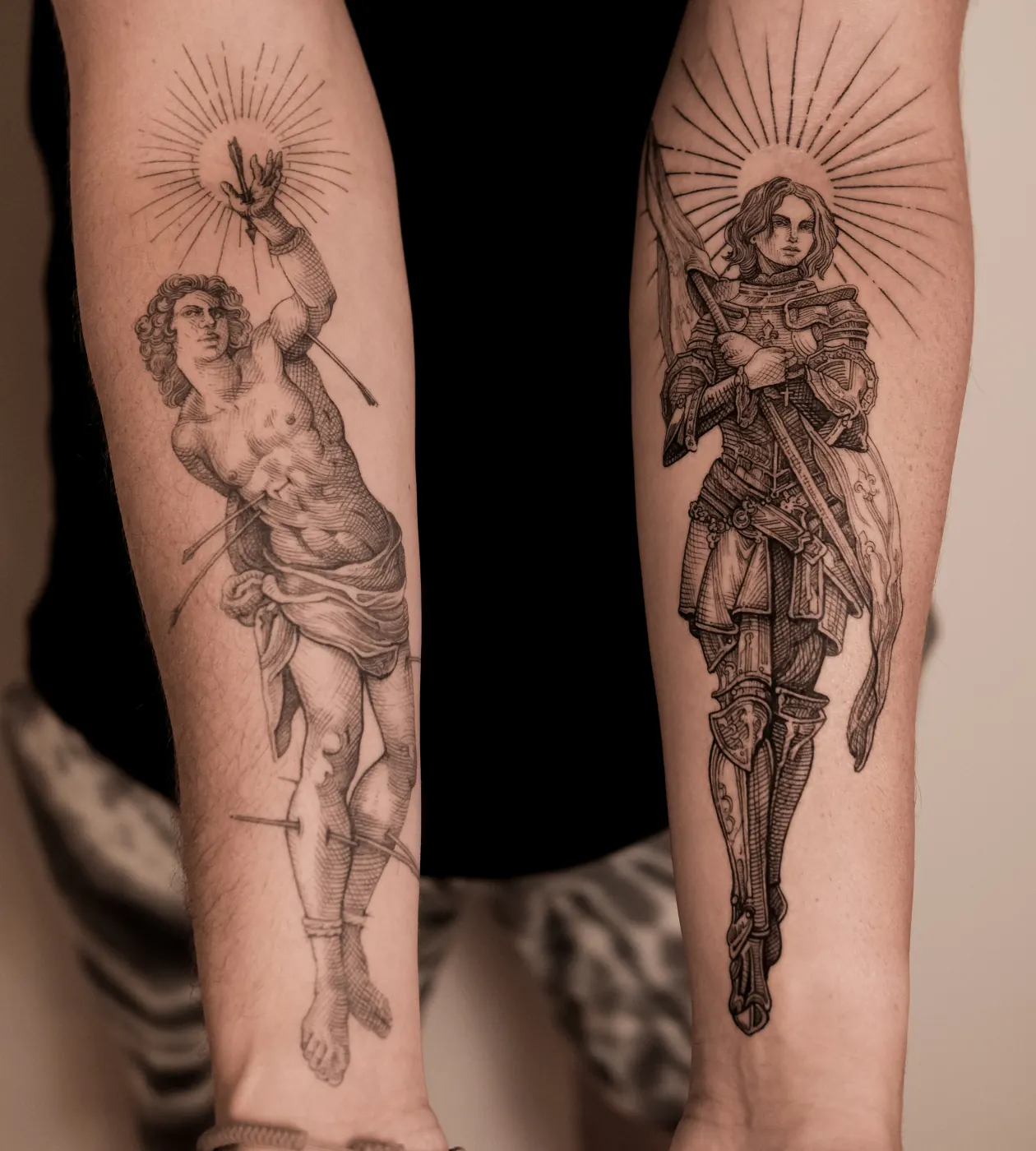
In contrapposto a figure rests on one leg, so the hips tilt one way and the shoulders the other. Ancient sculptors used it and the Renaissance revived it, this time with real anatomy underneath. It gives the body a living S-curve. If a figure in a design looks stiff, check the hips first. It's why Lescrow's two forearm figures, third below, don't look like they're standing to attention.


4. The Triangle: A Shape That Holds Together
Michelangelo's Pietà, carved in 1498 and 1499 and shown below, is built as a pyramid, with Mary's head at the top and her robes as the base. A stable shape like that reads clearly, even from across a room. It suits the body too, because the shoulder, chest and knee all have a triangle of their own to wrap a design around. Further down this page you can see Oksu's tattoo of the Pietà, which keeps the same pyramid on the ribs.

5. Fabric: Folds Tell the Story
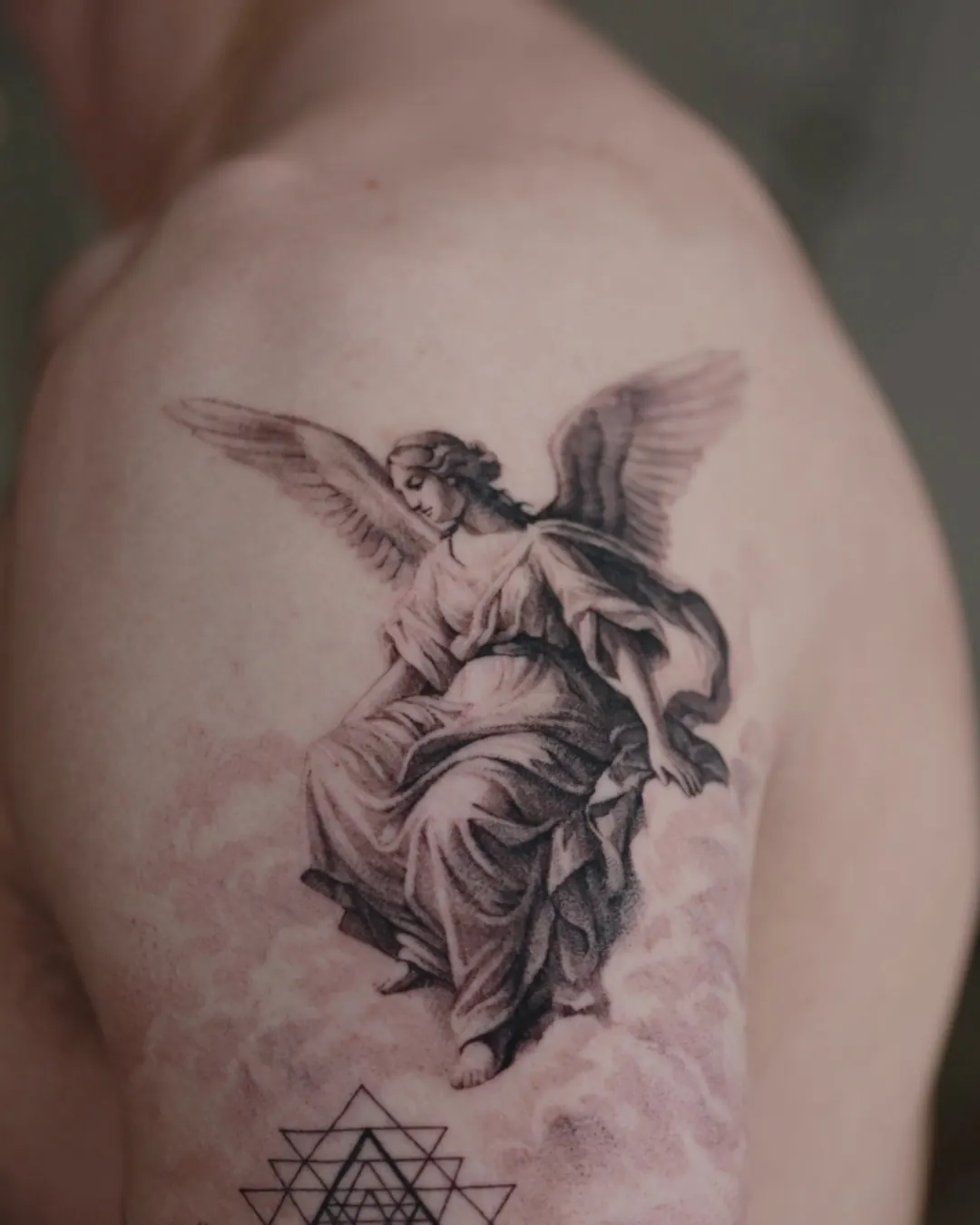
Vasari says the young Leonardo draped clay figures in clay-dipped cloth just to study the folds. Folds add rhythm, frame a figure and hint at the body under them without competing with the face. On Xsonseven's angel, pictured further down, the robes carry all the movement.
6. Hands: The Second Face
Hands are hard to draw, and they bring a figure to life. Leonardo made whole studies of them, like his drawing of a woman's hands. In Amalie Arsinevici's figure, the fingers say as much as the masked face above them. If your design has hands, treat them as a focal point and not an afterthought.
7. One Ink, Every Grey
Go back to Dürer's knight. One black ink, nothing but lines, and every grey you could want. Tattooing can work in the same way, and it's the logic behind the engraving tattoo style, where depth comes from line and hatching rather than soft shading. Look closely at Lescrow's figures and you can see it.
8. Save the Big Contrast
Not everything should shout. Keep the strongest dark and the strongest light for the focal point and let the rest stay quiet. Constanza leaves open skin around the piece, so your eye goes straight to the face.
Renaissance Tattoo Ideas
Start with what you want the tattoo to say, then pick the image. These are good starting points, grouped by artist.
Michelangelo Tattoos
- The Creation of Adam: two hands reaching, with a tiny gap between the fingers. It's part of the Sistine Chapel ceiling, painted between 1508 and 1512, and it works well on its own as a long, horizontal design about connection.
- David: carved between 1501 and 1504. A head and shoulders treatment gives you the famous stare and the marble look in a size that fits an arm.
- Pietà: a mother holding her son. It's about as direct an image of love and loss as you can wear, and a natural choice for a memorial piece.
- The Prisoners: unfinished figures meant for the tomb of Pope Julius II. The ones in Florence are still half inside the stone. As a tattoo, a figure that dissolves into open skin is a strong idea and very much its own thing.
Leonardo Tattoos
- Mona Lisa: the three-quarter pose is still one of the best angles for a portrait, because it shows character and volume at once.
- Vitruvian Man: his drawing from around 1490 of a man inside a circle and a square, a study of human proportion. It suits line-led work.
- Anatomy studies: the sketchbook look, with muscle and bone drawn as if on paper. A good fit for anyone who is fascinated by how bodies work.
Botticelli and Raphael Tattoos
- Venus: the face and windswept hair from The Birth of Venus, around 1485, are enough to make the image recognizable. The hair gives you movement along a forearm or shoulder.
- Cherubs: the two winged children leaning on their elbows at the bottom of Raphael's Sistine Madonna are a popular image in their own right, and they stay charming at a smaller size.
Dürer Tattoos
- Praying Hands: his drawing from around 1508 is a compact, instantly readable devotional image.
- Knight, Death and the Devil: a rider who keeps going while Death and the Devil crowd in beside him. It's a dense scene that rewards a big placement and an engraving treatment.
Custom Renaissance-Style Tattoos
You don't have to copy a masterpiece. A lot of the most personal work takes the principles and leaves the famous picture behind: your own subject, lit like a Leonardo. Raphael sets his philosophers under great arches, and an architectural frame can give any figure a stage, as the arch does in Amalie Arsinevici's piece below. On a larger piece, try aerial perspective, which Leonardo used in his backgrounds: distant things are paler and less detailed than near ones. In black and grey, that means lighter tones and softer edges to push a background back so the subject comes forward.



Best Placements for a Renaissance Tattoo
Choose the placement with the composition in mind. A good artist will fit the design to the way your body moves, so treat these as a starting point.
Forearm
Long and narrow, so it's ideal for a single standing figure, a vertical portrait or a saint with a halo. Lescrow's pair shows how well a full figure sits there. See our forearm tattoo guide for more.
Upper Arm and Shoulder
The curve of the shoulder suits busts, angels and draped figures, and it gives a face room to breathe. Xsonseven's angel is a good example.
Ribs and Chest
A broad surface for triangular compositions. The Pietà, a Madonna or a pair of figures sits comfortably here, as Oksu's piece shows.
Back
The only placement that can really take a multi-figure scene with architecture, in the spirit of The School of Athens. Our back tattoo ideas guide walks through the zones.
Sleeve
A sleeve lets you build a whole world: one option is to arrange it as a timeline running from early Renaissance figures to the High Renaissance. Plan it as one composition from the start, with a clear main image and quieter areas around it. Our tattoo sleeve ideas guide can help.
Renaissance Tattoos in Brooklyn
Monolith Studio is a contemporary tattoo studio at 77 Washington Avenue, Brooklyn, NYC 11205. The work in this post comes from six of our artists. Stevo and Oksu work in realism, from black and grey portraits to sculpture and religious imagery. Lescrow builds figures from line and hatching in an engraving style. Xsonseven does fine, detailed figurative realism, Amalie Arsinevici makes ornate figures framed by architecture, and Constanza works in fine line and black and grey realism.
Bring the painting or sculpture you love, or just the feeling you're after, and your artist will design around your body and your idea. For more on the style, see our realism tattoo guide and portrait tattoo guide. When you're ready, fill out the booking form and tell us which artist you'd like to work with.
Image credits: Raphael, The School of Athens (detail), Vatican. Albrecht Dürer, Knight, Death and the Devil (detail), 1513, National Gallery of Art. Michelangelo, Pietà, St. Peter's Basilica. Tattoos by Oksu, Stevo, Lescrow, Xsonseven, Amalie Arsinevici and Constanza.


