



What is rococo?
Rococo is an 18th century European style in painting, decoration, furniture and architecture, built on asymmetrical curves, shell forms, pale colors and a sense of play. Tate describes it as a reaction against the grandeur of Louis XIV's Versailles, and that's the easiest way in. Baroque was made to impress a crowd. Rococo was made for a drawing room.
What does rococo mean?
The word comes from the French rocaille, the rock and shell work used to decorate grottoes and fountains. The National Gallery in London traces it the same way. Some writers think the Italian barocco got mixed in, which would make rococo a kind of baby baroque, but that part is disputed.
Like baroque, it started as an insult. Students in the studio of Jacques-Louis David reportedly coined it in the late 1790s to sneer at the old-fashioned art of the previous generation, and one of them, Pierre-Maurice Quays, usually gets the credit. By the 1840s the word just meant out of date. Art historians use it neutrally now.
What is rococo style?
Rococo style is ornament first. Curls of carved and gilded wood run over walls and ceilings, mirrors and paintings sit inside them, and the line almost never runs straight. The subjects are small and private: flirting, dressing, music, a picnic that goes on all afternoon. It is the art of a society that had decided to enjoy itself, and it doesn't apologize for that.
When was the rococo period?
The rococo period ran from about the 1720s to the 1770s, and it is tied closely to the reign of Louis XV, who ruled France from 1715 to 1774. Dates vary between sources. The French ornament style called rocaille peaks around 1723 to 1759, while rococo painting and German churches carry on later.
The rococo time period in France
When Louis XIV died in 1715, his heir was five years old. Philippe d'Orléans ruled as regent until 1723, and he kept his court at the Palais-Royal in Paris instead of Versailles. The Régence, as those years are called, is where the lighter taste starts. Aristocrats who had spent decades standing around at Versailles went back to Paris and built themselves comfortable townhouses.
From Versailles to the Paris salon
Those townhouses, the hôtels particuliers, are where rococo grew up. Rooms got smaller and rounder. Paneling was painted white or pale colors and edged in gold. Instead of one huge ceiling glorifying the king, you got a ring of paintings set into the woodwork just above head height, where guests could actually look at them during a conversation.
Madame de Pompadour, who became Louis XV's mistress in 1745, was the most important patron of the style. She backed painters, architects and the royal porcelain works, which moved to Sèvres in 1756 on her initiative and was bought by the king in 1759. Her favorite painter, François Boucher, is a big part of this story.
Why rococo fell out of fashion
Rococo fell out of fashion because a new generation found it frivolous. Excavations at Herculaneum from 1738 and Pompeii from 1748 put ancient Roman rooms and objects back in front of Europe, and taste swung toward the straight lines and moral seriousness of Neoclassicism from around 1760. The critic Denis Diderot had praised Boucher early on. Later he turned on him and attacked his painting as artificial and not taken from nature. By the 1780s David was painting Roman oaths and Roman deaths, and pink skies looked like the past.

Characteristics of rococo art
The main characteristics of rococo art are curving, asymmetrical ornament, shell and plant forms, light pastel colors, gilding, and intimate, playful subjects. Watteau's Pilgrimage to Cythera, above, has most of them: a soft sky, a hillside of couples, nothing heavy anywhere.
Curves, shells and asymmetry
The C-curve and the S-curve are the signature lines of rococo. Designers stacked them, broke them and let them sprout leaves, so a mirror frame might look like a wave about to fold. Asymmetry was deliberate. A cartouche in a baroque palace sits square and balanced, while a rococo one leans to the side as if it were still growing. The shell, the original rocaille, turns up on walls, chair backs, silver and snuffboxes.
Pastel color and light
Rococo painters moved away from the deep shadows of the 1600s toward pale blues, pinks, creams and silvery greens. Light in a Boucher or Fragonard is soft and even, more like a spring morning than a spotlight. Pastel, the chalk medium, also had a moment. The Venetian portraitist Rosalba Carriera arrived in Paris in 1720 and was admitted to the French Académie that October, the first foreign born woman to get in.
Three characteristics of rococo art to remember
If you need three points for an exam answer, use these:
- Ornament built from asymmetrical C and S curves, shells and foliage, often gilded
- A light palette of pastels and white, with soft, even light instead of hard shadow
- Small scale, private subjects: love, leisure, music and mythology played for charm rather than drama
Rococo painting: the works to know
Rococo painting is mostly French, and three painters cover most of it: Watteau, Boucher and Fragonard. Each one sets the mood for a different part of the century.
Famous rococo paintings
- Antoine Watteau, Pilgrimage to Cythera, 1717: Louvre, Paris (a second version is in Charlottenburg Palace, Berlin)
- François Boucher, The Toilet of Venus, 1751: The Metropolitan Museum of Art, New York
- François Boucher, Madame de Pompadour, 1756: Alte Pinakothek, Munich
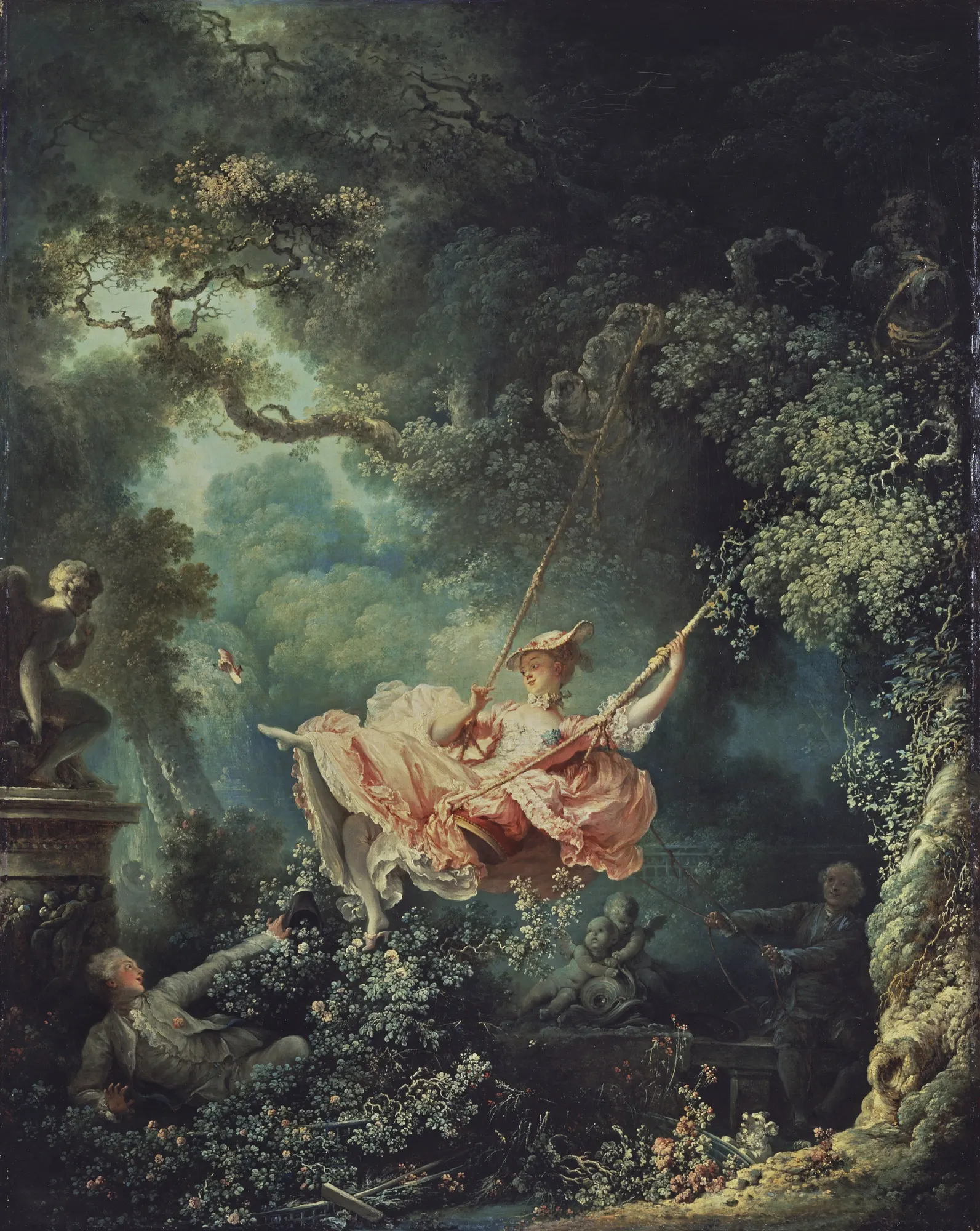
- Jean-Honoré Fragonard, The Swing, about 1767 to 1768: Wallace Collection, London
- Jean-Honoré Fragonard, The Progress of Love, 1771 to 1772 and about 1790 to 1791: The Frick Collection, New York
- Giovanni Battista Tiepolo, staircase ceiling of the Würzburg Residence, 1752 to 1753
The Swing is the one everyone knows. A young woman in a pink dress kicks a slipper into the air while a man hidden in the bushes looks up her skirt, and an older man works the ropes behind her. The Wallace Collection tells the story of the commission: a courtier first asked the painter Gabriel François Doyen for a picture of his mistress on a swing pushed by a bishop. Doyen said no and passed the job on. Fragonard said yes. The patron's name has never been firmly confirmed.


Rococo art style in portraits and fêtes galantes
Rococo had its own genre, the fête galante, a picture of elegant people in costume enjoying themselves outdoors. The French Académie created the category for Watteau when he presented Pilgrimage to Cythera as his reception piece in 1717. Nobody had a box to put him in, so they made one.
Portraits changed too. Boucher's Madame de Pompadour of 1756 shows the most powerful woman at court surrounded by books, letters and a shelf of music, in a dress so covered in roses and bows it almost becomes the subject. It is a political portrait dressed as a pretty one.
Rococo artists
The best known rococo artists are Antoine Watteau, François Boucher and Jean-Honoré Fragonard in France, and Giovanni Battista Tiepolo in Italy and Germany. Behind them stand designers and carvers whose names are less famous, and who shaped the style just as much.
Watteau
Antoine Watteau (1684 to 1721) was born in Valenciennes and died at 36. He became a full member of the Académie in 1717. For a style known for fun, his pictures feel quiet, even a little wistful. Cythera was the mythical island of Venus, and his couples drift across the hillside in pairs, half in conversation, half already somewhere else. You don't get a story so much as a mood, which is exactly what the Académie had no category for.
Boucher
François Boucher (1703 to 1770) won the Prix de Rome in 1723 and became First Painter to the King in 1765. He painted mythology, pastoral scenes and portraits of Pompadour, and he designed tapestries for the Beauvais and Gobelins works and models for porcelain. The National Gallery calls Pompadour his main patron. If you want one painter who is rococo through and through, it is him.
Fragonard
Jean-Honoré Fragonard (1732 to 1806) came from Grasse, studied with Chardin and then Boucher, won the Prix de Rome in 1752 and spent 1756 to 1761 in Rome. His brushwork is fast and loose, almost sketchy. Madame du Barry, Louis XV's last mistress, ordered four large canvases from him for her pavilion at Louveciennes in 1771. She sent them back in 1773 and hung neoclassical pictures by Joseph-Marie Vien instead. You can read the whole change of taste in that one rejection.
The happy ending is in Manhattan. Fragonard kept the canvases, added more around 1790 to 1791, and in 1915 Henry Clay Frick bought the set. According to the Frick, the Fragonard Room has existed since 1916, and after the museum reopened in April 2025 it is still on view at 1 East 70th Street. If you live in New York, it is the best rococo room you can walk into.
Tiepolo and rococo outside France
Giovanni Battista Tiepolo painted the ceiling over the grand staircase at the Würzburg Residence in Bavaria in 1752 and 1753. The Residence describes it as the largest ceiling fresco in the world, around 600 square meters, showing the four continents as Europeans of the time imagined them. The detail on this page is Asia, riding an elephant. Bavaria also built some of the most extravagant rococo churches anywhere, among them the Wieskirche, built by Dominikus Zimmermann between 1745 and 1754 and now a UNESCO World Heritage site.

Baroque vs rococo: what is the difference?
Baroque and rococo differ in scale, mood and purpose. Baroque, from about 1600, is grand, dark and dramatic, made for churches and kings. Rococo, from the 1720s, is lighter, smaller and playful, made for private rooms. Rococo grew out of baroque, and many historians treat it as the last phase of it.
Rococo vs baroque at a glance
- Mood: baroque wants awe and emotion, rococo wants charm and pleasure
- Color: baroque uses deep shadow and strong contrast, rococo uses pastels, white and gold
- Line: baroque ornament is heavy and symmetrical, rococo ornament curls off to one side
- Subjects: baroque paints saints, martyrs and kings, rococo paints lovers, picnics and goddesses at their dressing table
- Setting: baroque fills churches and palaces, rococo fills salons, bedrooms and pavilions
For the century before rococo, we'll have a full baroque guide on the blog soon. For the century after, when painters dropped ornament altogether, read about modernism in art.
Rococo style beyond painting
Rococo style was at least as much about rooms and objects as about pictures. Most people in the 1700s met it in a chair, a teacup or a dress, not on a canvas.
Rococo style furniture and interiors
Rococo furniture, often called Louis XV style in France, has curved cabriole legs, gilt bronze mounts known as ormolu and soft, deep chairs like the bergère. The word cabriole comes from the French for a goat's leap, which is a good description of the leg. Porcelain was the other luxury. Meissen in Saxony made Europe's first hard paste porcelain from 1710, and its figures of shepherds and lovers are rococo paintings you can hold.
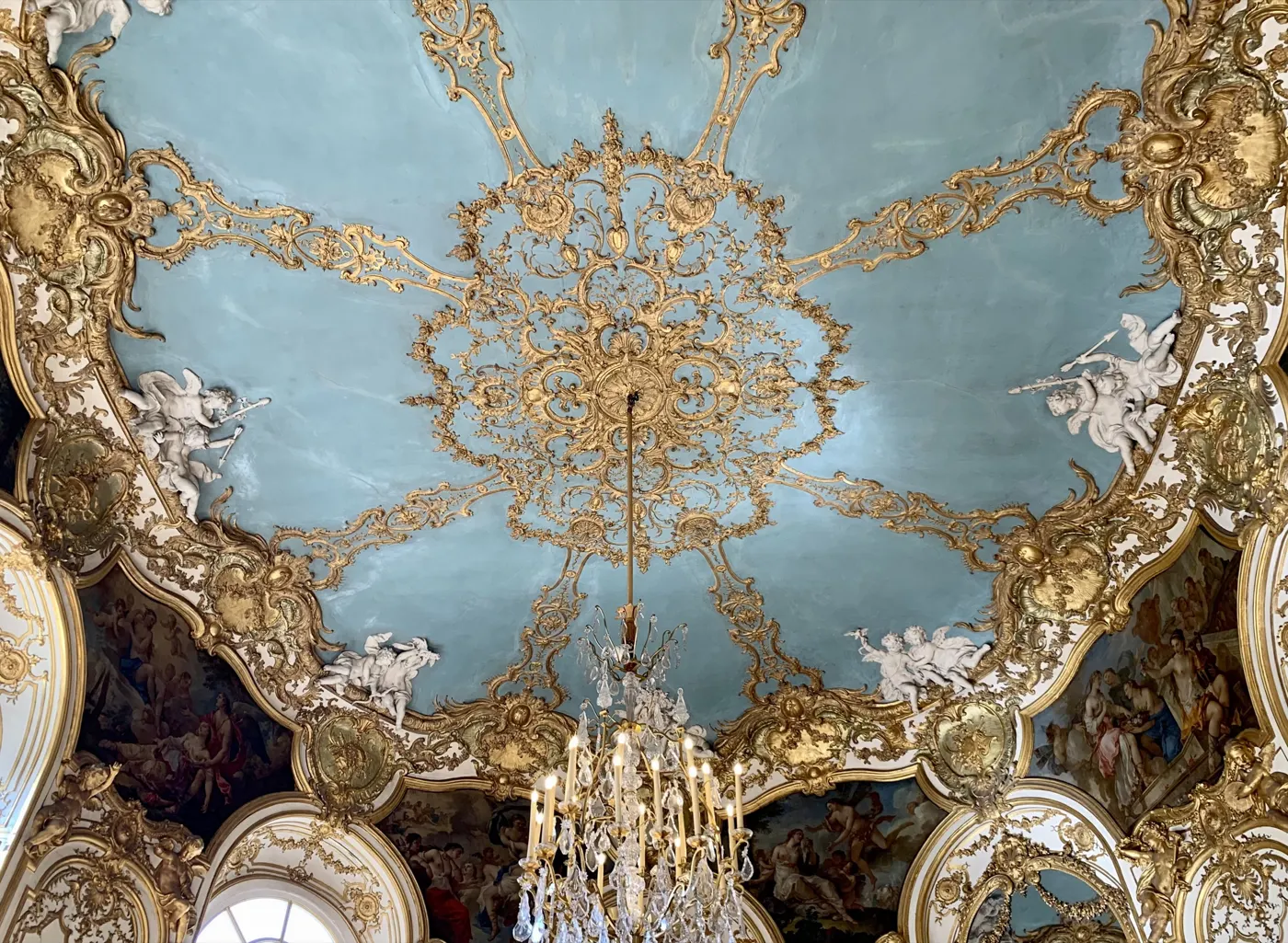
The Salon de la Princesse at the Hôtel de Soubise in Paris, shown here, is the room to look up. Germain Boffrand designed it in the late 1730s, an oval room where the walls melt into the ceiling through gilded curls, with paintings by Natoire, Boucher and Van Loo set into the frames. Designers such as Juste-Aurèle Meissonnier and Nicolas Pineau published and carved this kind of ornament, and Meissonnier's engraved designs, like the fountain print on this page, spread the look far beyond Paris.
Rococo style dress
The typical rococo style dress is the robe à la française: a gown with loose box pleats falling from the shoulders at the back, worn open over a petticoat and wide hip supports called panniers. People now call those back pleats Watteau pleats, though the name came in the 19th century. Pompadour's portrait shows the full effect, ribbons and lace and all. The Rijksmuseum has a good surviving example if you want to see the cut up close.
Rococo ornament and tattooing
A rococo tattoo is a tattoo that borrows rococo ornament: scrolls, shells, lace, filigree, fans and flowers that curl around the body instead of sitting in a box. It isn't a formal tattoo style with its own history. What exists is ornamental tattooing, a living style that draws on a lot of decorative traditions, and rococo is one of the closest relatives. Our ornamental tattoo page covers the style itself, and our guide to tattoo styles puts it next to the others.
Scrollwork on skin
The rococo line works on a body for a simple reason: bodies aren't flat or straight either. An S-curve can follow a collarbone, wrap a forearm or open across the shoulder blades, and asymmetry lets a design lean with the way you move. That's what Meissonnier and Pineau were doing on paneled walls. A tattooer does it on a back.
Look at the back piece in the large photo below, by Kaylee Ruiz, a resident artist at Monolith Studio who works in ornamental and fine line tattooing. Fine black scrolls frame the shoulders, dotted lines hang from them like lace, and a softer shaded center sits inside the frame the way a painting sits inside rococo paneling. We're not saying she set out to quote 18th century France. The tools are the same, though, and the family resemblance is hard to miss.
How ornamental artists use flowing line
Ornamental tattooers build a piece from repeated, flowing elements: scrolls, petals, beads of dotwork and fine lines that taper at the ends. The grid on this page shows four more pieces by Kaylee. One is a vine that climbs the whole arm, one a lace fan on the shoulder (very rococo, the folding fan was everywhere in the 1700s), one a forearm built from scrolls and paisley shapes, and one a symmetrical lace back piece. That last one is a good reminder that ornamental work doesn't have to be asymmetrical. Rococo just happened to love it.
If you want ideas to bring to an artist, a few that translate well: a rocaille cartouche framing a name or date, a fan or ribbon motif, a mirror frame shape around a small portrait, or a curling vine that starts at the wrist. Bring the pictures that made you want it. A Meissonnier print or a photo of a gilded salon tells an artist more than the word rococo will.


Rococo art FAQ
What is rococo art?
Rococo art is an 18th century European style, at its height from about the 1720s to the 1770s, that grew up in France after the death of Louis XIV. It uses curving, asymmetrical ornament, shell shapes, pastel colors and light, playful subjects such as love and leisure. Watteau, Boucher and Fragonard are its best known painters.
What are the main characteristics of rococo art?
The main characteristics are asymmetrical C and S curves, shell and plant forms, gilding, a pale pastel palette and soft, even light. Subjects are intimate and lighthearted: lovers in gardens, music, dressing, mythology played for charm. Painting, carved paneling, furniture and porcelain were usually designed to work together in one room.
What is the difference between baroque and rococo?
Baroque came first, from about 1600, and is grand, dark and dramatic, made for churches and royal palaces. Rococo followed from the 1720s and is lighter, smaller and more playful, made for private salons. Baroque relies on strong contrast and symmetry, while rococo prefers pastels, white and gold, and ornament that curls off to one side.
Who are the most famous rococo artists?
The most famous rococo painters are Antoine Watteau, François Boucher and Jean-Honoré Fragonard in France, plus Giovanni Battista Tiepolo, who painted huge ceilings in Italy and Germany. The Venetian pastellist Rosalba Carriera was also widely admired. Designers such as Juste-Aurèle Meissonnier and Nicolas Pineau shaped rococo ornament in interiors and prints.
When did the rococo period start and end?
The rococo period started in France after Louis XIV died in 1715 and is usually dated from the 1720s to the 1770s, close to the reign of Louis XV. It faded as Neoclassicism took over from around 1760, helped by the excavations at Herculaneum and Pompeii. In Germany and Central Europe rococo churches were still being built later.
Why is it called rococo?
The name comes from rocaille, the French word for the rock and shell decoration of grottoes and fountains. It began as an insult: students of Jacques-Louis David reportedly coined it in the late 1790s to mock old fashioned art. By the 1840s it meant out of date, and historians later adopted it as a neutral label.
Is there a rococo tattoo style?
There isn't a formal rococo tattoo style, but rococo ornament fits ornamental tattooing very well. Scrolls, lace, filigree, fans and flowing vines can follow the body's curves on a back, shoulder or arm. Bring your artist the paintings, prints or interiors you love and say whether the ornament or the soft color is what draws you.
Getting a rococo inspired tattoo in Brooklyn
Rococo ornament needs room to curl, so size and placement matter more than usual. A back, shoulder or full arm gives the line space to move, while a small piece works better as one clean motif, a fan or a cartouche, than as a crowded copy of a ceiling. Monolith Studio is a contemporary tattoo studio at 77 Washington Avenue, Brooklyn, NYC, and every piece is designed for your body and your idea. When you're ready, book a tattoo at Monolith Studio and tell us which artist you'd like to work with.
Image credits: Jean-Honoré Fragonard, The Swing, Wallace Collection, London. Antoine Watteau, Pilgrimage to Cythera, Musée du Louvre, Paris. François Boucher, Madame de Pompadour, Alte Pinakothek, Munich. François Boucher, The Toilet of Venus, The Metropolitan Museum of Art, New York. Giovanni Battista Tiepolo, Asia, staircase ceiling of the Würzburg Residence. Juste-Aurèle Meissonnier, fountain design, Rijksmuseum (CC0). Salon de la Princesse, Hôtel de Soubise, Paris, photo by Neoclassicism Enthusiast via Wikimedia Commons (CC BY-SA 4.0). Tattoos by Kaylee Ruiz, Monolith Studio.


